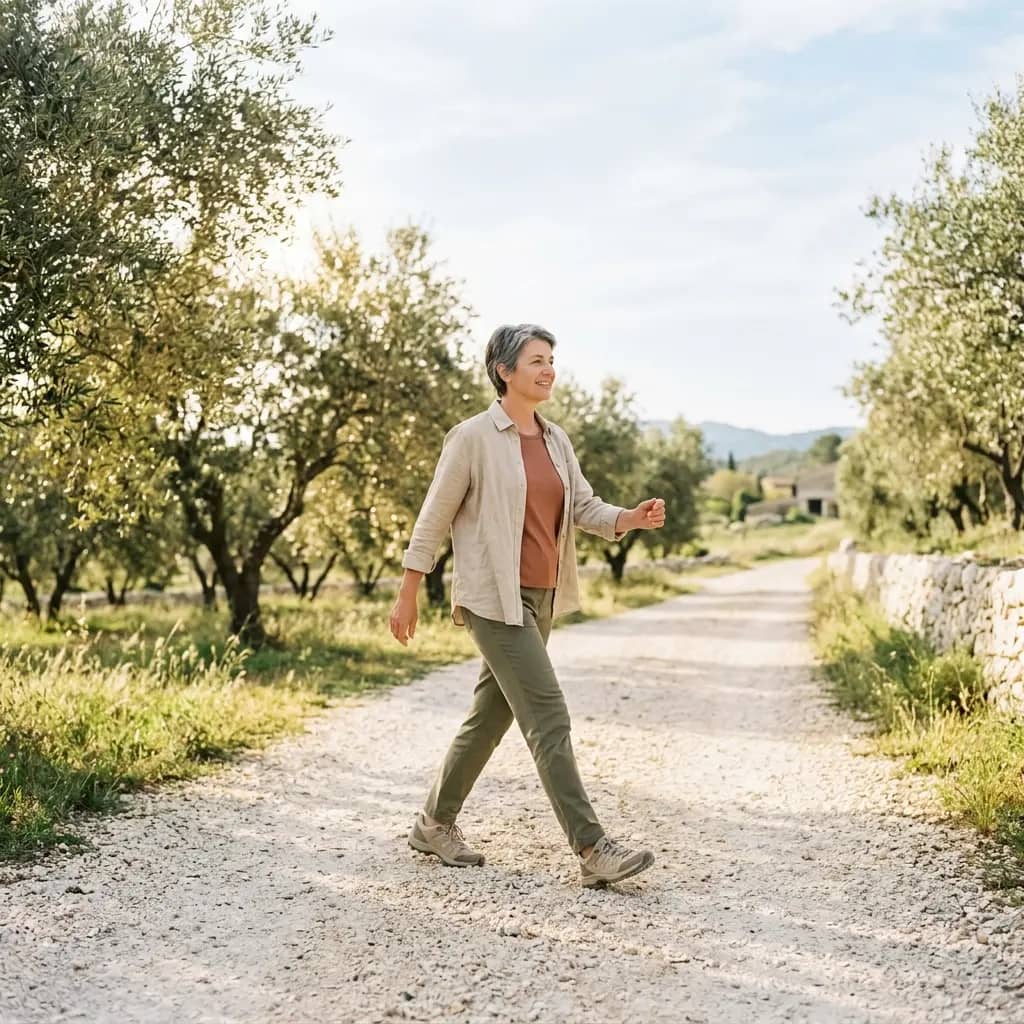
Japanese walking is interval walking: you alternate 3 minutes of brisk walking with 3 minutes of easy walking, repeat that five times for about 30 minutes, and do it at least four days a week. It comes from research by Hiroshi Nose, Shizue Masuki and colleagues at Shinshu University in Japan, where it is called interval walking training (IWT).
It is not an ancient tradition and it is not slow, meditative strolling. It is a simple, structured walk that asks a little more of your heart and legs for short, manageable stretches, then lets you recover. This guide is the hub for everything we have written about the method: what the original study tested, how to do a session, how to judge "brisk" without a heart rate monitor, a 6-week ramp for beginners, a sample week, and where shoes, weighted vests and weight-loss expectations fit in. Each section points you to a deeper guide when you want more detail.
What did the original Japanese walking study actually test?
The best-known trial was published in Mayo Clinic Proceedings in 2007 (Nemoto and colleagues, PubMed). It followed 246 adults with an average age of 63 (186 of them women) for five months, in three groups:
- No walking training.
- Continuous walking: at least 8,000 steps a day at a moderate pace, 4 or more days a week.
- Interval walking: 5 or more sets of 3 minutes of easy walking (about 40% of each person's peak walking capacity) followed by 3 minutes of brisk walking (above 70%), 4 or more days a week. A beep told walkers when to change pace.
In the interval group, knee extension strength rose by 13%, knee flexion strength by 17% and peak aerobic capacity for walking by 9%. All of these gains were larger than in the continuous walking group, and resting systolic blood pressure fell more as well. The authors concluded that interval walking may help protect against the age-related rise in blood pressure and the loss of thigh strength and fitness.
Two honest caveats. First, this was one group of middle-aged and older adults in one region of Japan, so results in other people may differ. Second, many participants did not stick to the instructions: the analysis only included those who met their targets, and in the interval group that was 42 of 87. Japanese walking works when you actually do it, which is why the starter ramp below begins gently.
Why 3 minutes? The researchers explained that most participants could not keep the brisk pace much longer than 3 minutes, and that 2 to 3 minutes of easy walking was enough to recover. The interval length is built around real people's limits, not an arbitrary number.
Notice what the study did not measure as a main outcome: body weight. That matters, because most of the bold claims you see online are about weight loss. We come back to that below.
How to do Japanese walking, step by step
- Warm up for 3 to 5 minutes at an easy, conversational pace. Let your shoulders drop and your arms swing.
- Brisk interval, 3 minutes. Speed up until you are breathing noticeably harder. Take quicker steps rather than longer ones, bend your elbows a little and drive the arm swing back.
- Easy interval, 3 minutes. Slow right down until you could chat comfortably. Do not stop; keep walking while your breathing settles.
- Repeat brisk and easy for 5 rounds in total. That is 30 minutes of intervals.
- Cool down with a few easy minutes, then a calf and hip flexor stretch if that feels good.
- Repeat on at least 4 days a week. The other days can be ordinary walks, rest, or gentle strength work.
The study put the easy interval first and the brisk one second. Our timer starts with brisk after an optional warm-up. In practice the result is the same: a warm-up, then five brisk and easy pairs.
How brisk is "brisk"? Use the talk test
The study measured intensity with an accelerometer. You do not need one. Your breathing gives you nearly the same information.
| Interval | How it feels | Talk test | Effort out of 10 |
|---|---|---|---|
| Easy (about 40% in the study) | Relaxed stroll, breathing settles | You can hold a full conversation | 3 to 4 |
| Brisk (above 70% in the study) | Purposeful, warm, breathing harder | Short sentences only, you could not sing | 6 to 7 |
| Too hard | Gasping, form falling apart | Only a word or two at a time | 8 or more |
If you reach the "too hard" row, ease off. Japanese walking is not a sprint and it is not race walking. For many women over 40, brisk on a flat path feels about right; if flat ground stops feeling like a 6, a gentle slope or slightly faster arm swing usually brings it back without extra impact.
Two technique cues make brisk easier to reach without straining. Stand tall with your ribs stacked over your hips, the same alignment we teach in our posture correction routine, and let your speed come from quicker steps and a stronger arm swing rather than reaching further with each foot.
A 6-week ramp for beginners
The full protocol is a jump if you are not walking regularly yet. This ramp builds the brisk minutes first and the number of rounds second. Each setting below opens our free Japanese walking timer with the numbers already filled in, so you only press start.
| Week | Brisk / easy | Rounds | Warm-up | Total time | Days per week | Timer preset |
|---|---|---|---|---|---|---|
| 1 | 1 min / 3 min | 4 | 3 min | 19 min | 3 | open |
| 2 | 2 min / 3 min | 4 | 3 min | 23 min | 3 | open |
| 3 | 2 min / 3 min | 5 | 3 min | 28 min | 4 | open |
| 4 | 3 min / 3 min | 4 | 3 min | 27 min | 4 | open |
| 5 | 3 min / 3 min | 5 | 3 min | 33 min | 4 | open |
| 6 onward | 3 min / 3 min | 5 | 3 to 5 min | 33 to 35 min | 4 or more | open |
Two rules for moving up: you finished every walk last week, and nothing hurt the next morning beyond normal tired legs. If either is a no, repeat the week. Repeating a week is not falling behind; it is how the habit sticks. This ramp is our suggestion for easing in, not part of the original study.
Already walking 30 minutes most days? Start at week 4. Not yet walking 20 minutes comfortably? Build the base first with our 30-day walking challenge, which starts at ten minutes a day, then come back to week 1 here.
A sample week of Japanese walking
The study asked for four or more interval days a week. It did not say what to do on the other days, so here is one balanced way to arrange a week once you reach week 5 of the ramp. Swap the days around to fit your life; the only rule is to avoid stacking more than two hard days back to back while you are new.
| Day | Session | Time | Why |
|---|---|---|---|
| Monday | Japanese walking, 5 rounds | 33 min | Interval day 1 |
| Tuesday | Short strength session at home | 15 min | Legs, hips and core support your walking |
| Wednesday | Japanese walking, 5 rounds | 33 min | Interval day 2 |
| Thursday | Easy walk or rest | 20 to 30 min | Recovery |
| Friday | Japanese walking, 5 rounds | 33 min | Interval day 3 |
| Saturday | Japanese walking, a different format | 30 to 35 min | Interval day 4, new route or hills |
| Sunday | Rest or a gentle stroll | Any | Recovery |
For the strength day, our wall Pilates routine takes 15 minutes and uses the wall for support, or try the gentle weighted vest beginner plan if you already own a light vest. On a day when 30 minutes will not happen, a 10-minute walking workout at home keeps the habit alive without counting as one of your four interval days.
Choosing a session format: outdoors, treadmill, home or hills
The 3+3 rhythm travels well. The effort stays the same and only the setting changes, which is useful when weather, time or space get in the way. We cover five complete formats, each with its own timer preset, in Japanese walking workouts for outdoors, treadmill and home. In brief:
| Your situation | Format | Timer preset |
|---|---|---|
| Good weather, a flat loop nearby | Classic outdoor route | 3 / 3 / 5 rounds |
| Want precise control or it is raining | Treadmill, change speed for each block | 3 / 3 / 5 rounds |
| Flat walking feels too easy | Hill or incline brisk blocks | 3 / 3 / 4 rounds |
| Only 20 minutes free | Quick version, 3 rounds | 3 / 3 / 3 rounds |
| Stuck indoors, little space | Marching or hallway loops | 3 / 3 / 5 rounds |
On a treadmill, raise the speed or the incline a little for the brisk minutes and lower it for the easy ones; walk without holding the rails if you can do so safely. On rainy days, a hallway loop or brisk marching in place with a strong arm swing still works. Our indoor walking challenge is a four-week plan built for walking at home, and the 10-minute walking workout at home is a short follow-along session with no equipment at all.
A quick version with three rounds is a smart fallback on busy days, but keep at least three of your weekly sessions at the full five rounds. That is the dose the study tested.
Common mistakes and quick fixes
- Going too hard in round one. If you cannot finish round five, your first brisk interval was a sprint. Aim for "short sentences", not "breathless".
- Stopping during the easy interval. Standing still lets your heart rate drop more than walking slowly. Keep moving.
- Over-striding to go faster. Long reaching steps land hard on the heel. Shorter, quicker steps are faster and kinder to knees and hips.
- Watching the clock. Checking your phone every minute breaks your rhythm. Let a timer chime the changes, the same way the study used a beep.
- Only doing intervals. Four interval days plus easy walks or rest on the other days is plenty. More hard days is not automatically better.
- Adding weight too early. Ankle weights or a vest during your first weeks change how you walk exactly when you are learning the rhythm. Master the method unloaded first.
What shoes work best for Japanese walking?
You do not need special shoes, but the brisk blocks are where poor footwear shows up: rubbing at the toes, tired arches, or a heel that slips. Look for three things:
- A flexible forefoot that bends where your foot bends, so quick steps feel natural.
- Room for your toes to spread, especially if your feet swell a little on longer walks.
- Enough cushioning for your surface. Pavement and treadmills feel different underfoot than park paths.
Walk in new shoes on easy days first, and save the brisk intervals for when they feel familiar. If you are shopping, our guide to the best shoes for Japanese walking and everyday brisk walks compares flexible, roomy and cushioned options, with notes on fit for wider feet.
Does Japanese walking help with weight loss?
Honestly, the original research cannot tell you. The 2007 study measured thigh strength, walking fitness and blood pressure, not weight loss. Any brisk walking adds to the energy you use each day, and the interval format packs more effort into the same 30 minutes than a gentle stroll, so it can be a useful part of a weight-management routine. It is unlikely to produce fast or dramatic changes on the scale by itself.
What tends to matter more over months is consistency, some strength work, sleep and what you eat. We go through the evidence and realistic expectations in Japanese walking for weight loss: what it can and can't do. If someone promises you a specific number of pounds from this method, that number did not come from the Shinshu research.
Can you add a weighted vest to Japanese walking?
You can, but not at the start, and not in the way most videos show. A vest adds load to every step, and the brisk blocks are already where effort and impact peak. Stacking extra weight on top of speed is the combination most likely to leave knees, hips or your lower back sore. Our approach, explained step by step in Japanese walking with a weighted vest, is simple:
- Learn the method unloaded until five full rounds feel comfortable for several weeks.
- Start light, at about 5% of your body weight or less (for a 160 lb woman, 8 lb at most, and less is fine).
- Wear the vest on easy walks and easy intervals first, and keep your brisk blocks vest-free until you are well adapted.
- Build slowly, adding time before weight. For walking, there is rarely a reason to go above about 10% of body weight.
If you are wondering whether a vest suits you at all, start with our guide to weighted vests for women: benefits, safety and how to start, which covers who should skip one and what the research does and does not support. When you are ready to choose, we compare light, low-bounce options in the best weighted vests for walking, broader picks for strength work and walking in the best weighted vests for women, and fit-focused options with longer straps in weighted vests for plus-size women.
Can you use ankle weights or wrist weights instead?
Keep your brisk intervals weight-free while you learn the method. Extra load at the ankle changes your stride exactly when you are trying to walk faster. If you later want ankle weights on easy walking days, our guidance for walking stays at 1 to 2 lb per ankle (1 lb if you are new), as explained in ankle weights for beginners, and the ankle weight calculator suggests a starting point for your situation. Light, contoured cuffs that stay put are compared in the best ankle weights for walking.
Wrist weights are a different trade-off: they add a little upper-body work but can tempt you to swing your arms stiffly. Read whether wrist weights are safe for walking and what they can realistically add in the benefits of wrist weights while walking before you buy a pair, then see the best wrist weights for walking and cardio. For the full comparison of where each kind of weight helps, our complete guide to ankle and wrist weights is the place to start.
Is there a mindful side to Japanese walking?
The interval method itself is about effort, not meditation. Still, the easy minutes are a natural place to notice your breath, your feet and what is around you, and many people find that makes the 30 minutes pass faster. If you want a calming practice for after your walk, try a few minutes with our breathing pacer.
Who should check with a doctor first
Brisk intervals ask more of your heart and lungs than a stroll. Talk to your doctor first if you have a heart or lung condition, high blood pressure, diabetes, joint pain that changes how you walk, are pregnant, or are returning after illness, surgery or a long break. The same applies before adding a weighted vest if you have osteoporosis, back problems or balance concerns. Stop and get help if you feel chest pain, faintness or unusual breathlessness.
None of this is meant to put you off. The participants in the original study were mostly women with an average age of 63, and the method was designed around what they could manage. Starting with shorter brisk intervals and using the talk test keeps the effort matched to you.
Where to go next, one step at a time
You do not need everything on this page at once. Pick the step that matches where you are this week.
- Not walking regularly yet? Start with the 30-day walking challenge, then begin week 1 of the ramp above.
- Ready for intervals? Open the week 1 timer preset and walk three times this week.
- Bored of the same loop? Rotate through the five Japanese walking workout formats.
- Feet complaining on brisk blocks? Check fit and flexibility against our walking shoe guide before you add more minutes.
- Five rounds feel easy for several weeks? Read weighted vests for women first, then decide whether a light vest belongs on your easy days.
The Bottom Line
Japanese walking is one of the simplest structured plans you can follow: 3 minutes brisk, 3 minutes easy, five rounds, four days a week, paced by the talk test rather than a gadget. The research behind it is about fitness, thigh strength and blood pressure in middle-aged and older adults, not dramatic weight loss, and it worked for the people who actually kept doing it. So start smaller than you think, let a timer call the changes, add variety before you add weight, and give it a few months before you judge it.
Frequently Asked Questions
Is Japanese walking the same as interval walking training?
Yes. "Japanese walking" is the popular name for interval walking training (IWT), developed at Shinshu University. The core pattern is 3 minutes brisk and 3 minutes easy, repeated five or more times, on four or more days a week.
How many days a week should I do Japanese walking?
The study asked participants to walk this way on four or more days a week. If you are new to exercise, three days a week for the first two weeks is a sensible start, then build to four.
Can I do Japanese walking every day?
You can, but you do not have to. Four interval days with easier walks or rest days in between gives your legs time to recover. If you walk daily, keep some of those walks easy.
Does Japanese walking help with weight loss?
The 2007 study measured strength, fitness and blood pressure, not weight loss, so it does not answer that question. Any regular walking adds to your daily activity, and food, sleep and stress all play a part in weight as well.
What if I can't keep up the brisk pace for 3 minutes?
Shorten the brisk interval to 1 or 2 minutes and keep the easy interval at 3. Our timer accepts half-minute steps, so you can build up gradually, as in the week 1 and 2 settings in the ramp above.
Can I do Japanese walking on a treadmill?
Yes. Change the speed, or add a small incline, for the brisk blocks and lower it for the easy ones. The talk test works the same way on a treadmill as outdoors, so let your breathing, not a number on the display, decide what brisk means for you.
Should I wear a weighted vest for Japanese walking?
Not while you are learning it. Once five rounds feel comfortable, you can try a light vest of about 5% of your body weight or less on easy walks and easy intervals, keeping your brisk blocks unloaded until you are well adapted.
Is Japanese walking safe for women over 50?
The original study's participants had an average age of 63, and most were women. Starting with shorter brisk intervals and using the talk test keeps the effort personal. Check with your doctor first if you have a heart condition, high blood pressure or another health concern.