Somatic Pilates is a slow, mostly floor-based way of doing Pilates in which you pay as much attention to how a movement feels as to how it looks. Beginners use small ranges, unhurried breathing and very few repetitions. A 12-minute routine, three or four times a week, is enough to start, and the first sessions should feel almost too easy.
"Somatic" simply means relating to the body as you sense it from the inside. There is no single official method or governing body, so classes and videos labelled somatic Pilates vary a lot. What they share is the pace and the focus on sensation. Below you will find a clear comparison with classical and wall Pilates, a full beginner routine with breath counts, a four-week plan, and signs that you are doing too much.
Somatic vs Classical vs Wall Pilates
| Somatic Pilates | Classical mat Pilates | Wall Pilates | |
|---|---|---|---|
| Pace | Very slow, often 4 to 6 breaths per movement | Moderate, set rhythm | Moderate |
| Focus | Noticing sensation, releasing effort you do not need | Precise form, core strength, set sequence | Alignment feedback from the wall, strength |
| Range of motion | Small to medium | Medium to full | Medium |
| Typical reps | 3 to 6 | 5 to 10 | 8 to 12 or timed holds |
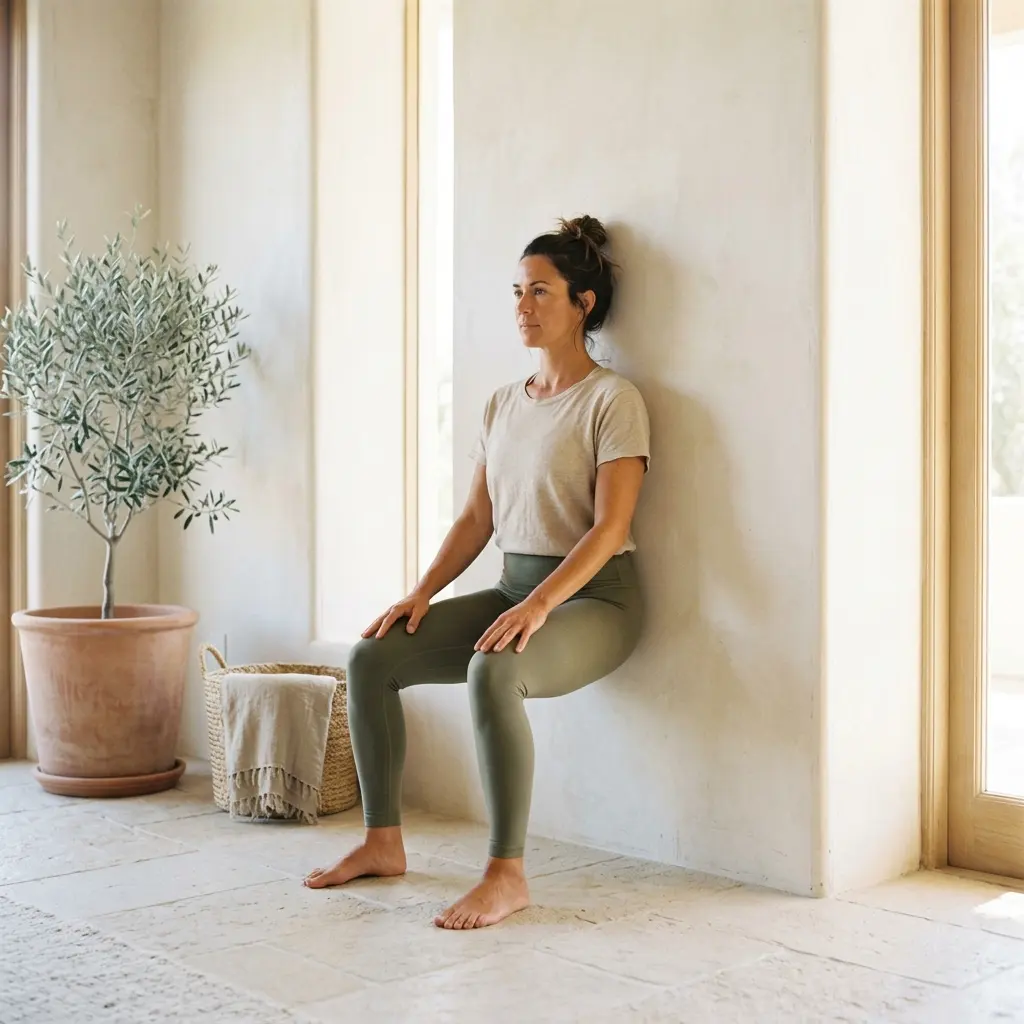
| Position | Mostly lying on the floor | Floor | Standing and lying with feet on the wall |
| Feels like | Gentle, calming, sometimes surprisingly hard to stay slow | A workout | A workout with support |
| Good first choice if | You feel stiff, tense or disconnected from your body | You want structure and core strength | You want guidance on alignment and no floor transitions |
They are not rivals. Many people start with somatic work, then add a short wall Pilates routine or Pilates board exercises once they feel more connected to their core. If you enjoy slow floor work, the gentle tantric yoga poses sequence has a similar unhurried pace.
What You Need
- A mat or rug with some cushioning. Thicker foam suits this style, since you spend most of the time lying down; our mat guide explains the trade-offs.
- A small pillow or folded towel for your head. The same props suit lying practices; our guide to yoga nidra props covers what helps.
- Fifteen quiet minutes. Phone on silent.
The 12-Minute Beginner Routine
Move at about half the speed you think you should. Breathe through your nose if that is comfortable. After each exercise, pause for one or two breaths and notice what changed. At the 4-in, 6-out breathing pace, one breath takes about 10 seconds, so 6 breaths is about a minute; the counts below are set so each exercise fills its 2 minutes.
1. Constructive rest breathing (2 minutes)
Lie on your back, knees bent, feet flat and hip-width apart, head on the pillow. Rest one hand on your belly and one on your lower ribs. Breathe in for about 4 counts and out for about 6 counts. Notice: your ribs widening sideways on the inhale and softening on the exhale. Let go of: clenched jaw, shoulders pushing into the floor.
2. Pelvic tilts (2 minutes)
From the same position, exhale and gently roll your pelvis so your lower back flattens toward the floor. Inhale and roll it the other way so a small arch appears. Do 6 slow tilts, each one over a full breath, with one resting breath between tilts (about 12 breaths in all). Notice: how little effort this needs. Too much: if your glutes or abs grip hard, make the movement smaller.
3. Pelvic clock (2 minutes)
Imagine a clock face on your pelvis, with 12 at the belly button and 6 at the tailbone. Slowly roll your pelvis from 12 toward 3, down to 6, toward 9 and back to 12. Make 2 slow circles in each direction. Notice: any part of the circle that feels jumpy or stuck. Go slower there instead of pushing. This kind of slow, inward attention is also the core of many grounding exercises for anxiety.
4. Knee sways (2 minutes)
Feet a little wider than your hips. Let both knees drift slowly to the right, only as far as your opposite hip can stay heavy, then bring them back to center and go to the left. Do 3 each side, 2 breaths per sway (about 12 breaths in all). Notice: a gentle stretch around the waist and outer hip. Skip if: it pinches in your lower back; make it smaller first.
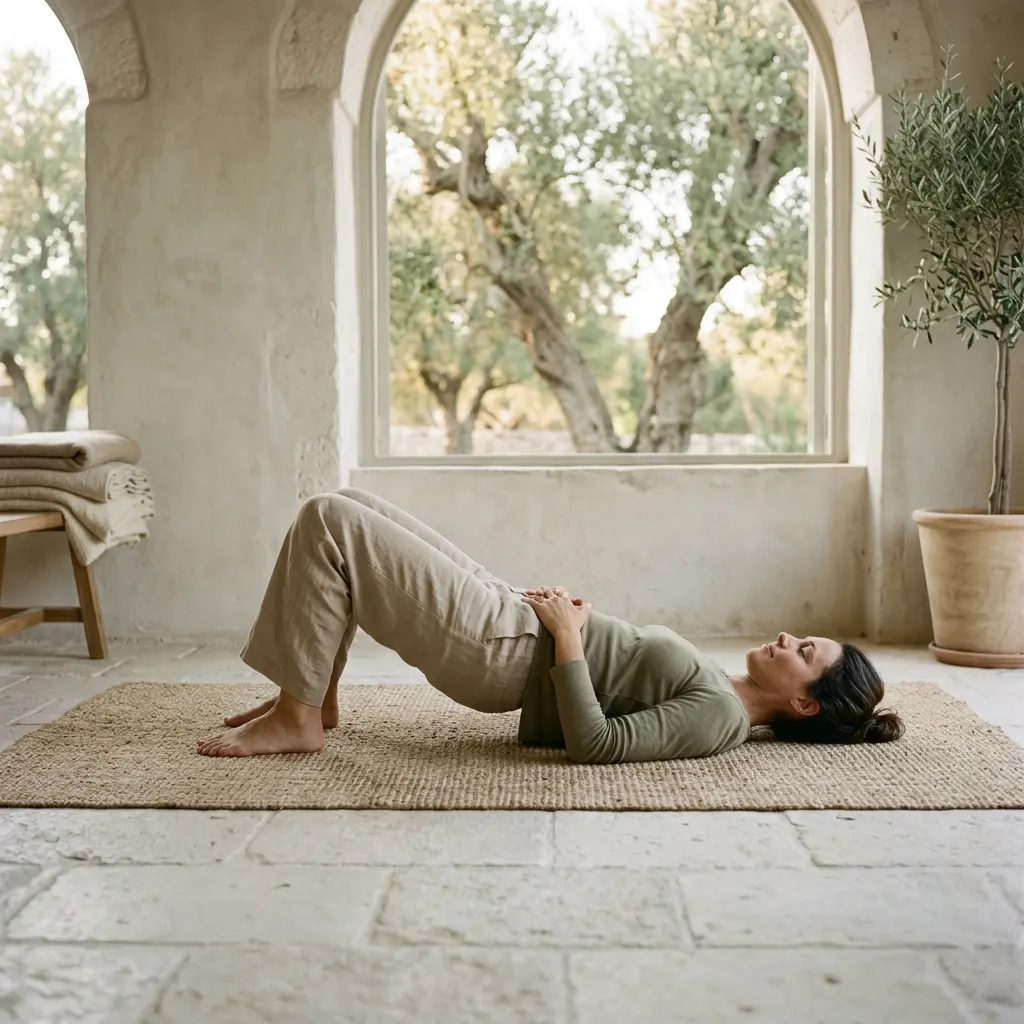
5. Slow bridge (2 minutes)
Feet hip-width apart, arms by your sides. Exhale and peel your hips up one vertebra at a time, only as high as feels easy. Inhale at the top. Exhale and lower one vertebra at a time. Do 2, taking about 6 breaths each (about 12 breaths in all). Notice: which parts of your back lift as one block. That is useful information, not a failure.
6. Side-lying arm circles (2 minutes)
Lie on your right side, knees bent, head on the pillow, arms stretched in front at shoulder height. Slowly lift the top arm and draw a large, easy circle overhead and behind you, letting your eyes follow your hand and your chest open. Do 3 circles each way, then switch sides. Notice: the stretch across the chest. Too much: if your shoulder catches, make the circle smaller.
Finish with three slow breaths back in constructive rest. If you like a visual rhythm for the breathing parts, our free breathing pacer works well with step 1 and the closing rest.
Your 4-Week Progression
| Week | Sessions | What changes | Goal |
|---|---|---|---|
| 1 | 3 per week | Do the routine as written, smallest comfortable range | Learn the sequence, stay slow |
| 2 | 3 to 4 | Add 1 rep to tilts, sways and bridges; the session grows to about 14 minutes | Notice sensations without changing them |
| 3 | 4 | Slow down further: bridge at 8 breaths per rep; expect about 15 minutes | Smooth, even movement through the stuck spots |
| 4 | 4 | Add 5 minutes of classical basics, such as single-leg slides and gentle leg lifts (about 20 minutes in all) | Carry the same attention into stronger work |
By week four, many people find it easier to notice when they are holding tension during the day, for example in the jaw or shoulders. At a desk, a few desk yoga poses are a quick way to let that tension go. You can also use the first two exercises on their own in the evening; some people find them a good way to wind down before bed, alongside other ways to lower cortisol for better sleep or a session of yoga nidra.
Signs You Are Doing Too Much
This matters especially for women over 40 coming back to exercise, where the temptation is often to push to "make it count". If low energy is part of the picture, our guide to menopause fatigue covers how a little daily movement fits alongside sleep and stress.
- You are holding your breath or breathing high in the chest. Make the movement smaller.
- Your jaw, neck or shoulders are clenching. Pause, let them go, then continue.
- A movement feels jumpy or shaky and you keep forcing through it. Go slower and smaller instead.
- You feel sore the next day in your back or neck. Use smaller ranges and fewer reps for a week.
- Pain is sharp, pinching, or spreads into a leg or arm. Stop that exercise. If it persists, see a doctor or physical therapist.
- You feel dizzy getting up. Roll onto your side and sit up slowly.
If you have osteoporosis or low bone density, keep the bridge low and skip any deep forward-rounding movements. If you are pregnant or have a back condition, check with your doctor or midwife before starting.
Common Beginner Mistakes
- Treating it like a workout. Speed and more reps miss the point. Slower is the method.
- Chasing a bigger range. The bridge is not better when it is higher.
- Skipping the pauses. The moment between exercises is where you notice what changed.
- Expecting to feel "worked". Somatic Pilates often feels like very little while you do it. Pay attention to how you move and sit afterward; our posture correction routine adds strength work for the upper back once you are ready.
Frequently Asked Questions
What is somatic Pilates?
Somatic Pilates is a slow form of Pilates that combines basic Pilates movements with close attention to physical sensation. You move in small ranges, breathe steadily and pause to notice what changed. There is no single official method, so classes and videos vary.
Is somatic Pilates good for beginners?
Yes. It is one of the gentlest ways to start Pilates because it uses small movements, few repetitions and mostly lying positions. It also teaches the breath and control that make other Pilates styles easier later.
How long should a somatic Pilates session be?
For beginners, 10 to 15 minutes three or four times a week is a good start. Short, regular sessions tend to work better than one long one, especially while you are learning to move slowly.
Can somatic Pilates help with stress?
Many people find the slow pace and long exhales calming, and it can be a useful wind-down at the end of the day. It is not a treatment for anxiety or other health conditions, but it can be one gentle part of a calmer routine.
Do I need a certified instructor for somatic Pilates?
You can start safely at home with a simple routine like the one above. Because there is no single certification for somatic Pilates, if you want a teacher, look for someone with a recognised Pilates or movement qualification who works slowly and adapts to you.