When you purchase through links on our site, we may earn an affiliate commission. Here's how it works.
Healing through art, in the everyday sense, means using drawing, painting, clay or coloring to slow down and settle your mind. Small studies suggest it can help: short art sessions have been linked with lower levels of the stress hormone cortisol, and coloring a structured design such as a mandala has been linked with lower anxiety, regardless of artistic skill. It is a gentle self-care practice, not a cure, and it is different from art therapy, which is a clinical profession.
This page gives you three things: an honest summary of what the research shows, a clear line between art at home and art therapy (and when the second is the better choice), and a step-by-step 15-minute mandala practice you can do tonight with a pencil and a sheet of paper.
What does research show about art and stress?
The research is encouraging but small, so it is worth knowing exactly what was found.
- Art-making and cortisol. In a 2016 study from Drexel University, 39 adults spent 45 minutes making art with markers, paper, clay and collage materials. Cortisol, measured in saliva, dropped in about 75 percent of participants, and prior art experience made no significant difference. There was no control group doing a non-art activity, so we cannot say art was better than, for example, a quiet walk.
- Mandalas and anxiety. In the study that started the adult coloring trend, researchers at Knox College found that coloring a mandala reduced anxiety the most, coloring a plaid pattern reduced it somewhat, and free-form drawing on a blank page did not reduce it at all. Later studies have largely supported the effect, and some found that other structured patterns can work about as well as mandalas. The useful takeaway is that structure seems to matter more than the shape itself.
What this means for you: a short, structured creative session is a reasonable, low-cost way to calm down after a hard day, alongside other habits in our guide on how to reduce stress at work. A blank page with no direction can feel stressful, so give yourself a frame to work within.
Art at home or art therapy: what is the difference?
Both use art, but they are not the same thing, and it helps to know which one you need.
| Art-making at home | Art therapy | |
|---|---|---|
| Who leads it | You | A credentialed art therapist |
| Training behind it | None needed | A graduate degree in art therapy plus supervised clinical hours; board certification (ATR-BC) through the Art Therapy Credentials Board |
| Main purpose | Relaxation, focus, creative enjoyment | Working through emotional or psychological difficulties as part of treatment |
| Good for | Everyday stress, winding down, a mindful hobby | Trauma, grief, anxiety or depression, life transitions, conditions where talking is hard |
| What you need | Paper, pencils, 15 minutes | A referral or direct contact with a qualified therapist |
Art therapists are trained mental health professionals, and requirements vary by state. If you look for one, ask about their credentials (for example ATR-BC, and any state license) and their experience with what you are going through.
The 15-minute mandala practice
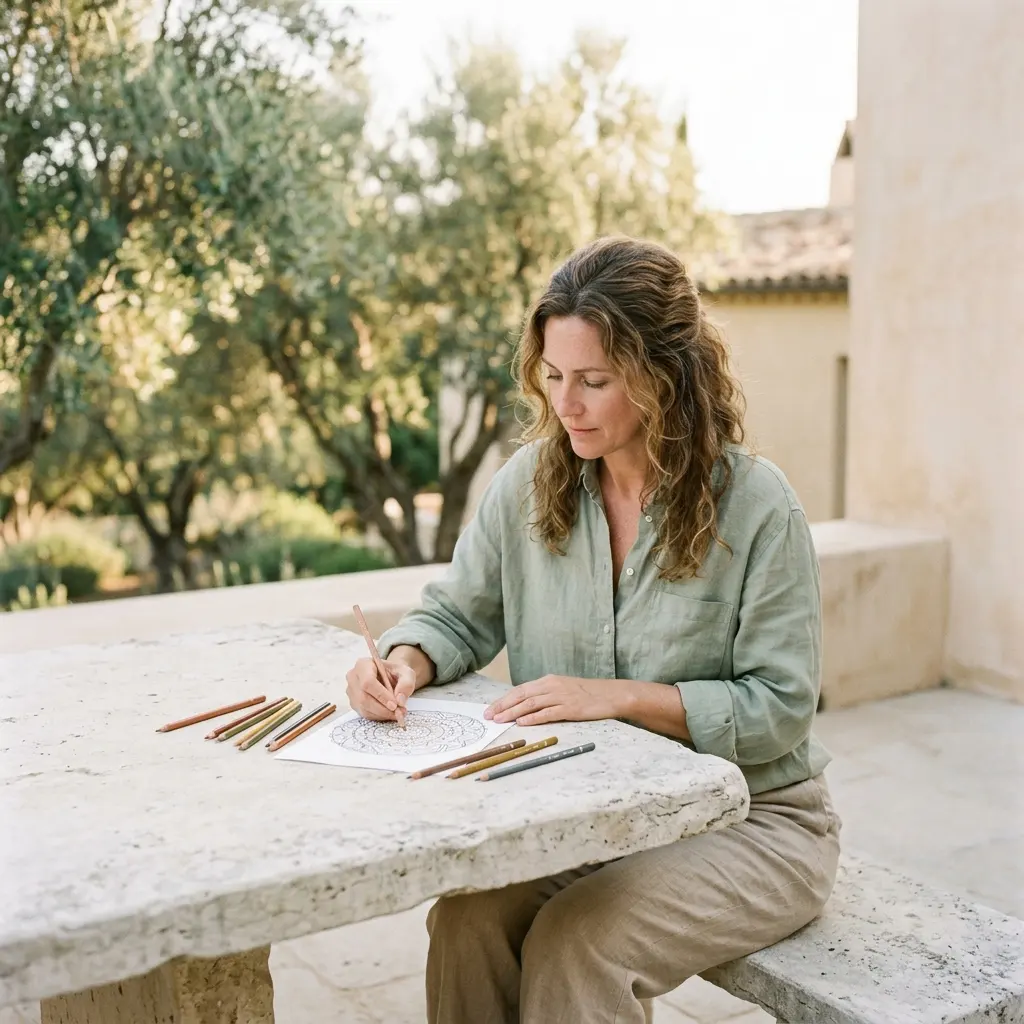
This practice uses the structure the research points to. You need a sheet of paper, a pencil, something round to trace (a mug or small plate) and a few colored pencils or markers. Set a timer so you are not watching the clock.
Minutes 0 to 2: Settle
- Sit at a clear table. Put your phone face down or in another room. (If that feels hard, a 7-day digital detox builds the habit gradually.)
- Take five slow breaths, making each exhale a little longer than the inhale.
Minutes 2 to 4: Build the frame 3. Trace a circle in the middle of the page. 4. Lightly draw a vertical and a horizontal line through the center, then two diagonals. You now have eight equal slices. This is the structure that keeps the blank page from feeling daunting.
Minutes 4 to 11: Pattern 5. Start in the center with a small shape: a dot, a circle or a tiny flower. 6. Work outward in rings. In each ring, repeat the same simple shape in every slice: petals, arches, dots, waves, triangles. 7. Keep your attention on the pencil tip. When your mind wanders to your to-do list, notice it and bring it back to the next shape. That return is the practice, exactly as in a 5-minute mindfulness meditation.
Minutes 11 to 14: Color 8. Pick two or three colors that feel calming to you today. Fill in one ring at a time, slowly. 9. Do not fix "mistakes". A wobbly line is part of the drawing.
Minute 14 to 15: Close 10. Put the pencil down, look at the whole page for a few breaths, and notice how your body feels compared with when you sat down.
If you want help with the breathing part at the start, use our breathing pacer:
Common stumbling blocks and how to handle them
- "I can't draw." You do not need to. The Drexel study found experience made no difference, and a mandala is just repeated simple shapes.
- Blank-page anxiety. Use a frame: a traced circle, a printed mandala, a coloring book or a paint-by-numbers kit. Free drawing with no direction was the condition that did not reduce anxiety.
- Judging the result. Decide before you start that no one will see it. You can throw it away, and the practice still counts.
- Rushing. If you finish in five minutes, add another ring. Slowness is part of the point.
- Strong emotions come up. That can happen. Pause, ground yourself with slow breathing or our grounding exercises, and consider talking to a professional if it keeps happening.
Other gentle art practices to rotate in
- Art journaling (10 minutes). Write one sentence about your day at the top of a page, then fill the rest with colors and shapes that match the feeling. A dedicated notebook helps; our list of mindfulness journals and books has options.
- Clay or dough (10 minutes). Roll, press and shape without a goal. The hand movement itself can feel grounding.
- Nature prints (20 minutes). Collect leaves, paint one side and press them onto paper. Take only fallen, plentiful ones, as our guide to eco spirituality suggests.
- Water painting (5 minutes). Paint with water on a surface where the image fades, which takes away any pressure to make something good.
If color is part of what draws you to this, our guide to color therapy covers what color can and cannot do for mood.
Supplies worth considering
We have not lab-tested these products. The notes below come from the listings and publishers' descriptions.
Guided Art Therapy Card Deck: a deck of 75 art activities with step-by-step instructions, time estimates and reflection questions, developed by a licensed, board-certified art therapist for self-guided use.
- Who it suits: anyone who freezes at a blank page and wants a prompt each time.
- Downside: it is self-guided, so it is not a substitute for working with an art therapist, and some activities need supplies you may not have.
The Original Buddha Board: a reusable water-painting board; you paint with water and the image fades as it dries.
- Who it suits: perfectionists and anyone who wants a mess-free, five-minute ritual with no result to judge.
- Downside: there is nothing to keep, and it is a single-color, simple medium that some people outgrow quickly.
BAISITE Paint by Numbers Kit for Adults: a two-pack of 16x12 inch floral canvases for beginners.
- Who it suits: people who relax best with a lot of structure and enjoy a finished piece to hang.
- Downside: the small numbered sections take patience and good light, and a full canvas takes many sessions.
When to look for an art therapist
Home art practice is lovely for everyday stress. Look for a credentialed art therapist, or talk to your doctor, if you are dealing with trauma, grief, ongoing anxiety or low mood, or if difficult feelings come up each time you create. If you are in crisis in the US, call or text 988.
An evening session also fits neatly into a wider wind-down to lower cortisol for sleep. For more ways to calm a busy mind, see our anti-stress toolkit and explore our healing and spirituality section.
Frequently Asked Questions
Can art really help with healing?
Art-making can support emotional well-being: small studies link short art sessions with lower cortisol and structured coloring with reduced anxiety. At home it works as a calming, mindful practice. For trauma, grief or mental health conditions, art therapy with a trained professional is the appropriate route.
Do I need to be good at art to benefit?
No. In the Drexel study, prior art experience made no significant difference to the drop in cortisol. The benefit comes from focused, unhurried making, so simple shapes and repeated patterns work as well as anything more ambitious.
What is the difference between art therapy and coloring books?
Coloring is a self-care activity you do on your own for relaxation. Art therapy is a clinical practice led by a credentialed art therapist who has graduate training and uses art-making as part of mental health treatment. Coloring can be calming, but it is not therapy.
Why does mandala coloring feel calming?
The circle and repeating pattern give your attention a clear, gentle task, which researchers have suggested draws people into a meditation-like state. Studies found free drawing on a blank page did not reduce anxiety, while structured designs did, so the structure seems to be the key ingredient.
How often should I do an art practice for stress?
A few times a week is a realistic start, and even 15 minutes is enough. Consistency matters more than length. Many people find an evening session works well as a screen-free way to wind down before bed.