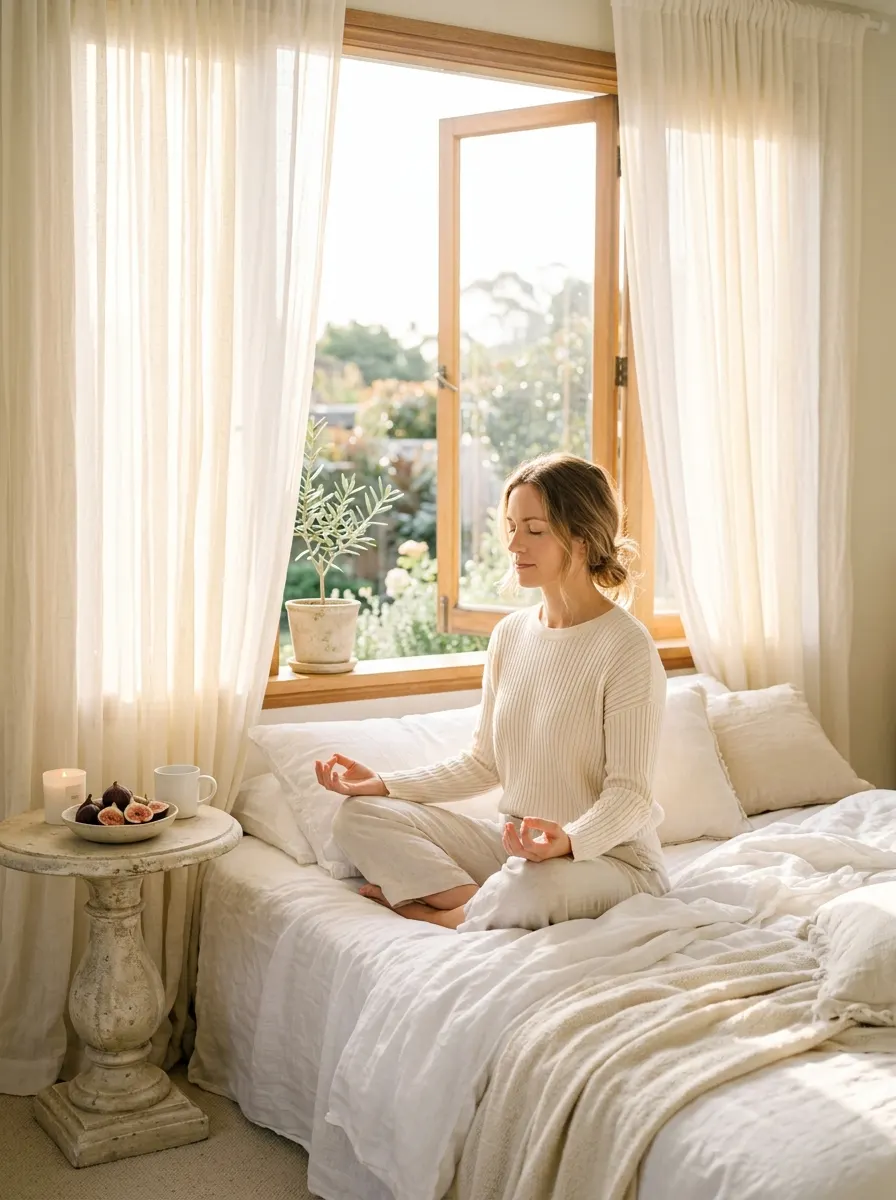
A 5-minute morning mindfulness meditation works best as five 60-second steps: slow breathing, three specific things you are grateful for, a quick body scan, one intention for the day and a gentle stretch. You do not need an app, a cushion or a quiet house, only a timer and a habit you already have, such as waiting for the kettle or the coffee maker.
Five minutes is short on purpose. The aim is a routine you will actually repeat on a rushed Tuesday, not a perfect session on a free Sunday. Below is the minute-by-minute plan, a word-for-word script you can read or record, and fixes for the mornings when it falls apart.
The 5-minute plan at a glance
Set a timer that chimes every minute (most phone timers or interval apps can do this), or just glance at a clock.
| Minute | Step | What you do | Cue to move on |
|---|---|---|---|
| 0:00 to 1:00 | Breath | Breathe in for 4, out for 6, through the nose if comfortable | About 6 slow breaths |
| 1:00 to 2:00 | Gratitude | Name three specific things, one sentence each, in your head | Third item named |
| 2:00 to 3:00 | Body scan | Sweep attention from scalp to feet, about 10 seconds per area | You reach your toes |
| 3:00 to 4:00 | Intention | Pick one word or short sentence for the day | You have said it three times |
| 4:00 to 5:00 | Stretch | Neck rolls, shoulder rolls, seated side reach, seated twist | Back to stillness, one last breath |
Step-by-step: the five minutes
Minute 1: slow breathing
Sit on a chair with both feet on the floor, or on the edge of your bed. Let your hands rest on your thighs. Breathe in for a count of four, and out for a count of six. That is about six breaths in a minute. Keep it easy: if the counts feel strained, use 3 in and 5 out.
Cue: let the shoulders drop a little on every exhale.
If you prefer a visual guide, the free breathing pacer can run a one-minute slow pattern for you.
Minute 2: three specific things
Bring to mind three things you are grateful for, and make each one specific. Not "my family" but "the way my daughter laughed at dinner." Not "my home" but "the warm floor in the kitchen this morning." Spend about 20 seconds on each and notice whether anything shifts in your chest or face as you think of it.
Specific beats general here, and it is the same idea behind our gratitude meditation script and the 30-day gratitude practice if you want to go deeper.
Minute 3: the 60-second body scan
A full body scan can take twenty minutes. This one is a quick sweep: roughly 10 seconds per area.
- Scalp, forehead and jaw (unclench your teeth)
- Neck and shoulders
- Arms and hands
- Chest and belly (notice the breath moving)
- Hips and lower back
- Legs and feet on the floor
You are not trying to relax each part, only to notice it. If you find tension, a slow exhale toward that spot is enough. For what regular practice may do for the body over time, see our look at the physical benefits of meditation.
Minute 4: one intention
Choose one word or one short sentence for the day, in the present tense and phrased as what you will do, not what you will avoid. Examples: "Patient." "I take one thing at a time." "I pause before I answer." Repeat it silently three times.
Cue: if nothing comes, use "Gentle" and move on. Searching for the perfect intention defeats the purpose. If you want to picture the day's first step in more detail, our guide to visualization for goals shows how to rehearse the steps rather than just the result.
Minute 5: mindful stretch
Stay seated and move slowly, matching each movement to a breath:
- Two slow neck rolls in each direction
- Five shoulder rolls backward
- Reach your right arm overhead and lean gently left for two breaths, then switch
- A gentle seated twist: hand on the opposite knee, look over your shoulder for two breaths, then switch
Finish with one full breath in stillness before you stand up. Skip any movement that hurts, and keep neck rolls small if you have neck problems. The same chair-based moves work later in the day as desk yoga between tasks.
The habit anchor: kettle, coffee or toothbrush
The step most people skip is deciding exactly when this happens. A routine tied to "sometime in the morning" tends to disappear by Wednesday. Tie it to something you already do every day:
- Kettle or coffee maker: start the five minutes when you switch it on. Many kettles take a few minutes, so you may finish the breath and gratitude steps before it clicks off, then do the rest while it steeps.
- After brushing your teeth: sit on the edge of the bath or bed straight afterwards. If you also scrape your tongue in the morning, that 30-second step works as a cue too.
- Before you look at your phone: leave the phone in another room until the five minutes are done. If the phone habit is hard to break, a 7-day digital detox offers a gentle plan.
Write your anchor down in one sentence: "When I switch on the kettle, I sit down and breathe." That sentence is your plan, and a mindfulness journal is a good place to keep it next to your gratitude notes.
A script you can read or record
Some people find it easier to follow a voice. Read this slowly into your phone's voice recorder once, and play it back each morning. Pause where it says (pause).
Sit comfortably, feet on the floor. Breathe in for four... and out for six. (pause) Again, in for four... out for six. Let your shoulders drop. (pause for the rest of the minute)
Now bring to mind one specific thing you are grateful for. (pause) A second one. (pause) And a third. (pause)
Bring your attention to your scalp and jaw. Let the teeth part. (pause) Neck and shoulders. (pause) Arms and hands. (pause) Chest and belly, feel the breath. (pause) Hips and back. (pause) Legs, and feet on the floor. (pause)
Choose one word for today. Say it to yourself three times. (pause)
Roll your neck slowly. Roll your shoulders back. Reach one arm up and lean, then the other. Twist gently each way. (pause) One last breath in stillness. Your morning practice is done.
When it falls apart: troubleshooting
| Problem | Try this |
|---|---|
| "I forget to do it." | Your anchor is too vague. Attach it to one physical action, like switching on the kettle. |
| "My mind wanders the whole time." | That is normal and part of the practice. Each time you notice and come back counts. |
| "The kids or partner interrupt." | Do the first two minutes only. A two-minute practice still keeps the habit alive. |
| "I feel sleepy." | Sit upright on a chair rather than in bed, and open your eyes for the stretch. |
| "Breath counting makes me anxious." | Drop the counts and simply notice the breath, or make the exhale only slightly longer. |
| "Five minutes feels pointless." | Keep going for two weeks before you judge it. Notice how the first hour of your day feels, not the five minutes. |
Morning practice versus bedtime practice
This routine is designed to set the tone for the day, which is why it ends with an intention and movement. To carry that calm into a busy job, our guide to reducing stress at work uses 2-minute breaks built on the same steps. If your main goal is falling asleep, a different approach fits better: see our mindfulness techniques for better rest, which are slower and end in stillness rather than a stretch, or try yoga nidra for beginners on evenings when you want a longer, guided rest.
Meditation is generally considered low risk, but a small number of people find it stirs up anxiety or difficult feelings. If that happens, shorten the practice, keep your eyes open, and talk to a health professional if it continues.
Frequently Asked Questions
Can 5 minutes of meditation really make a difference?
Five minutes will not change everything, but it is long enough to settle your breathing and choose how you want to start the day. The bigger benefit is consistency: a short practice you repeat daily usually does more than a long one you skip. Judge it after two weeks, not after one morning.
What is the best time for morning mindfulness?
The best time is the one attached to something you already do every day, such as making coffee or brushing your teeth. Doing it before checking your phone helps, because messages pull your attention into the day immediately.
Do I need an app for a 5-minute morning meditation?
No. A phone timer that chimes every minute is enough, or you can record the script above in your own voice. Apps can help if you like guidance, but they also add a screen to your morning.
What if I cannot sit still for 5 minutes?
Start with two minutes (breath and gratitude) and add a minute each week. If stillness feels hard, a few quick exercises for busy days can come first. You can also do the whole routine standing, or swap the body scan for a slow walk around the kitchen while you notice your feet.
Should I meditate before or after coffee?
Either works. Many people like starting the routine as the kettle or coffee maker switches on, so the waiting time becomes practice time. If caffeine makes you jittery, you may find it calmer to meditate first.