Grounding exercises are short techniques that bring your attention back to the present moment when anxiety pulls it into worst-case thinking. They work through your senses, breath and body: naming what you can see, slowing your exhale, feeling cold water on your hands or pressing your feet into the floor. They will not cure anxiety, but they can lower the peak of a wave enough for you to think clearly again.
This guide gives you 12 grounding techniques with exact steps, explains which one fits which kind of anxious moment, and is honest about what the research does and does not show. Pick two or three, practise them on an ordinary day, and they will be there when you need them.
What are grounding exercises, and how do they help anxiety?
Anxiety is usually about the future: what might go wrong, what someone might think, what that symptom might mean. Your body reacts to those thoughts as if the danger were in the room, with a faster heart, shallow breathing and tight muscles. Grounding interrupts that loop by giving your attention something concrete and neutral to do right now.
Clinicians have used grounding for decades. The best-known written description comes from Lisa Najavits's Seeking Safety treatment model, which sorts grounding into three types:
- Mental grounding: occupying your mind with neutral detail, such as describing your surroundings or counting backwards.
- Physical grounding: using touch, temperature and movement, such as holding a cool object or stamping your feet.
- Soothing grounding: kind, calming self-talk, such as reminding yourself where you are and that this feeling will pass.
Most of the techniques below fall into one of those three types. Having one from each is a good starting kit, because what helps on a crowded train is not always what helps at 3 a.m.
How to do the 5-4-3-2-1 grounding technique
The 5-4-3-2-1 method is the most searched grounding exercise for a reason: it needs no tools, works almost anywhere and is easy to remember under stress.
- Pause and breathe out slowly once. You do not have to calm down first. Just start.
- 5 things you can see. Name them, silently or out loud, with detail: "a blue mug with a chip on the handle", not just "mug".
- 4 things you can feel. The weight of your feet in your shoes, the chair against your back, the texture of your sleeve, air on your face.
- 3 things you can hear. Traffic, a fridge hum, your own breathing. Listen for the quietest sound in the room.
- 2 things you can smell. If nothing is obvious, sniff your wrist, your coffee or a hand cream. You can also name two smells you like.
- 1 thing you can taste. Toothpaste, tea, or simply the taste in your mouth right now.
- Check in. Notice whether anything has shifted, even slightly. If the wave is still high, go round again or add a breathing technique.
What makes it work: detail. Rushing through the list like a checklist keeps your mind racing. Slowing down and describing each item forces your attention to stay outside your thoughts for a minute or two.
Honest note on evidence: 5-4-3-2-1 is widely used in therapy and by mental health services, but it has been studied far less than breathing or mindfulness. Small studies, mostly with students before exams, suggest it can reduce in-the-moment anxiety. Treat it as a well-tested practical tool rather than a proven treatment.
12 grounding exercises for anxiety, step by step
1. The 5-4-3-2-1 senses scan
Described above. Best for: racing thoughts, feeling detached or "not here", anxiety in public places where you can keep your eyes open.
2. Long exhale breathing
Breathe in through your nose for a count of 4, then out through softly pursed lips for a count of 6. Repeat for 2 to 5 minutes. A longer exhale than inhale is the common thread in most calming breath patterns, and it is easy to do without anyone noticing. Our guide to mindfulness techniques for sleep uses the same pattern at bedtime.
You can set this exact rhythm in our free breathing pacer and simply follow the circle for three minutes.
3. The physiological sigh
Take a normal breath in through your nose, then a second short sip of air on top of it, then a long, slow breath out through your mouth. Do this 2 to 5 times. In a 2023 Stanford study published in Cell Reports Medicine, five minutes a day of this "cyclic sighing" for a month improved mood and lowered breathing rate more than the same time spent on mindfulness meditation. It was one remote study, but it is a reassuring sign for a technique that costs nothing.
4. Box breathing
In for 4, hold for 4, out for 4, hold for 4. The holds give a busy mind something to count. If holding your breath makes you feel more anxious, which happens to some people, skip the holds and use long exhale breathing instead.
5. Cold water on your hands or face
Run cool water over your wrists and hands for 30 seconds, or hold a cold drink can, a cool pack wrapped in a cloth, or an ice cube in your palm. Splashing cold water on your face while holding your breath briefly is part of the "TIPP" skills in dialectical behaviour therapy (DBT), used to bring very intense emotion down quickly. Use cool rather than icy if you have a heart condition, Raynaud's or circulation problems, and skip the face version if you are unsure.
6. Feet on the floor
Sit or stand, press both feet firmly into the floor and notice the pressure through your heels, the balls of your feet and your toes. Rock gently from heel to toe a few times. Say to yourself: "My feet are on the floor. I am here." This is one of the most discreet techniques and works in meetings, on buses and in waiting rooms.
7. Hold a grounding object
Carry something small with an interesting texture: a smooth stone, a ring, a worry bead, a piece of fabric. When anxiety rises, hold it and describe it to yourself: its temperature, weight, edges and colour. Pairing the object with calm practice on good days makes it a stronger cue on hard ones.
8. Categories game
Pick a category and name as many items as you can: dog breeds, cities beginning with B, every vegetable in your kitchen, songs from one artist. Counting backwards from 100 in sevens works too. This is pure mental grounding, useful when your body feels fine but your thoughts will not stop.
9. Orienting to the room
Slowly turn your head and let your eyes travel around the space as if you were seeing it for the first time. Notice exits, corners, light and colours. Then say the date, the time and where you are. This helps especially when anxiety feels like being somewhere else, such as replaying an old memory.
10. Move for two minutes
Walk briskly down a corridor, march on the spot, shake out your hands and arms, or do a few slow shoulder rolls and stretches. Movement uses up some of the stress energy your body has prepared. If you work at a desk, our desk yoga sequence gives you four chair poses that take two minutes. A short walking workout at home works on days when anxiety builds slowly.
11. Progressive muscle relaxation, short version
Tense one muscle group for about 5 seconds, then release it and notice the difference for 10 seconds. Work from your feet up: feet, calves, thighs, hands, shoulders, face. A full round takes about 5 minutes. This suits evenings and the build-up of tension over a day more than sudden panic.
12. Kind self-talk
Speak to yourself as you would to a friend: "This is anxiety. It is uncomfortable, and it will pass. I have got through this before." Name the feeling without arguing with it. Some people write a short card with three sentences that help them and keep it in a wallet or phone case. If writing helps you, a mindfulness journal can hold these phrases along with notes on what worked.
Which grounding technique should I use, and when?
There is no single best technique. The one that works is the one you can actually do in that moment. This table is a starting point.
| Situation | Try first | Back-up |
|---|---|---|
| Sudden wave of panic | Physiological sigh, cold water | Feet on the floor |
| Racing thoughts, can't focus | 5-4-3-2-1, categories game | Long exhale breathing |
| Feeling unreal or "far away" | Orienting to the room, cold object | 5-4-3-2-1 |
| In public, need to be discreet | Feet on the floor, grounding object | Long exhale breathing |
| Tense body after a long day | Progressive muscle relaxation | Move for two minutes |
| Lying awake worrying at night | Long exhale breathing, body scan | Kind self-talk |
| Before a stressful event | Box breathing, move for two minutes | Grounding object |
For the night-time version, a gentle yoga nidra session or a guided sleep meditation goes further than a quick technique. If stress hormones and a busy evening are the bigger pattern, our wind-down for lowering cortisol before sleep shows how to build the whole evening around calm.
Do grounding exercises work for panic attacks?
They can help you ride a panic attack out, but they may not stop it. Panic attacks usually peak within about ten minutes and then fade, even though they feel endless. Fighting the sensations tends to add a second layer of fear on top of the first. Grounding gives you something to do while the wave passes: breathe out slowly, name what you see, feel your feet, remind yourself that this is panic and it will pass.
A useful habit is to practise your chosen techniques when you are calm, two or three times a week. Under stress the brain falls back on what is familiar, so a technique you have rehearsed is far easier to reach than one you read about once.
Chest pain, breathlessness and a racing heart can also come from physical conditions. If you have never had a panic attack before, if symptoms feel different from usual, or if you are not sure, get medical help first.
How to build a daily grounding habit
Grounding works best as a skill you keep warm, not only an emergency tool. A light routine:
- Morning, 2 minutes: three physiological sighs and one round of 5-4-3-2-1 while the kettle boils. A short morning mindfulness meditation can take the place of this on calmer days.
- Midday, 1 minute: feet on the floor and three long exhales before you open your inbox or start the afternoon.
- Evening, 5 minutes: short progressive muscle relaxation or slow breathing with the pacer.
Over a few weeks, notice which technique you reach for without thinking. That is your anchor. Our anti-stress toolkit matches other calming tools to different stress types if you want to widen the kit.
Is "earthing" the same as grounding?
No. In psychology, grounding means the attention techniques above. "Earthing", sometimes also called grounding, is a different idea: that standing barefoot on soil or grass, or using conductive mats, transfers electrons from the earth into the body and changes inflammation, sleep or stress.
The research on earthing is small and early. Most studies have had few participants, short follow-up and limited blinding, and several come from researchers connected to companies that sell earthing products. That is not enough to recommend buying mats or sheets for anxiety.
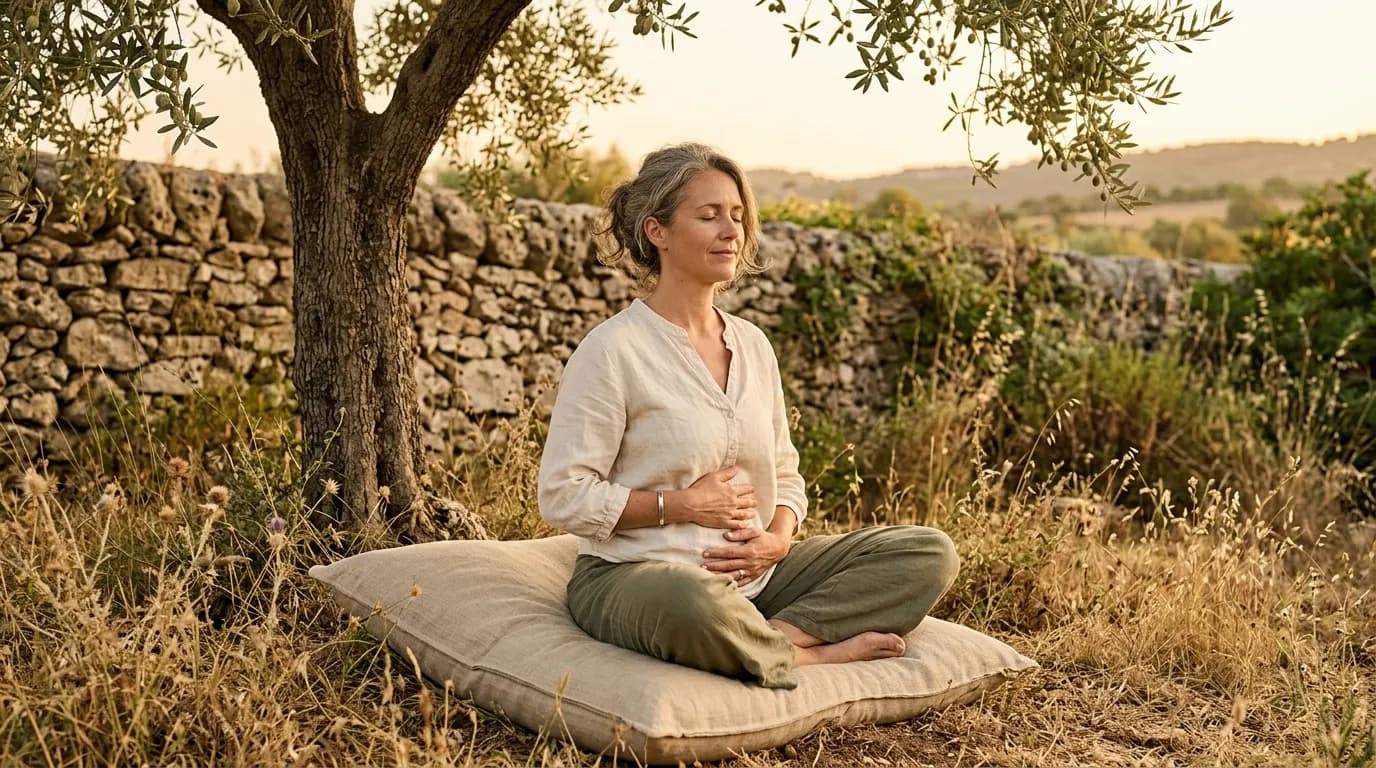
What is reasonable to say is simpler. Standing barefoot on cool grass, feeling the texture under your feet and noticing the air around you is a very good sensory grounding exercise in its own right, and time outdoors in nature is pleasant for many people. If that appeals to you, our guide to practising eco spirituality offers gentle ways to spend time outside with attention.
What grounding can and cannot do
What it can do:
- Lower the intensity of an anxious moment enough to think and choose your next step.
- Give you a sense of control when anxiety makes you feel helpless.
- Build, with regular practice, a quicker route back to calm.
What it cannot do:
- Treat an anxiety disorder, panic disorder, PTSD or depression on its own.
- Remove the causes of stress in your life, such as overload, conflict or poor sleep.
- Replace medication or therapy that a professional has recommended.
Effective treatments for anxiety exist, including cognitive behavioural therapy (CBT), which typically teaches techniques like these as one part of a wider plan. If you are curious about how meditation affects the body more broadly, our look at the physical benefits of meditation sums up what the evidence shows. Complementary practices some people enjoy, such as reiki or ThetaHealing, can sit alongside care but should never replace it.
When should you get help for anxiety?
Grounding is self-care, and it is fine to need more than that. Talk to your doctor or a licensed therapist if:
- You feel anxious most days and it has lasted several weeks.
- Panic attacks keep happening, or you avoid places because you fear one.
- Anxiety affects your sleep, work, eating or relationships.
- You use alcohol or other substances to cope.
- Midlife hormonal changes seem to be part of the picture. Perimenopause can bring anxiety, poor sleep and fatigue that are worth discussing with a doctor.
If you are thinking of harming yourself or feel you cannot keep yourself safe, contact a crisis line or emergency services now. In the US you can call or text 988. In other countries, your local emergency number or a national crisis line can connect you with someone straight away. Reaching out is a strong and sensible step, not a failure.
Where to go next
- Start today: choose one breathing technique and one sensory technique from the list above. Practise each once, while you feel calm.
- Use the pacer: set 4 in, 6 out in the breathing pacer and try three minutes this evening.
- Widen the kit: browse the healing and spirituality section for gentle practices that support a calmer baseline.
The Bottom Line
Grounding exercises are simple, free and portable ways to bring yourself back to the present when anxiety rises. The 5-4-3-2-1 senses scan, a slow breath with a longer exhale, cool water on your hands and feet pressed into the floor are the best place to start. Practise them on calm days so they are easy to reach on hard ones, keep your expectations honest, and get support from a doctor or therapist if anxiety is shaping your days.