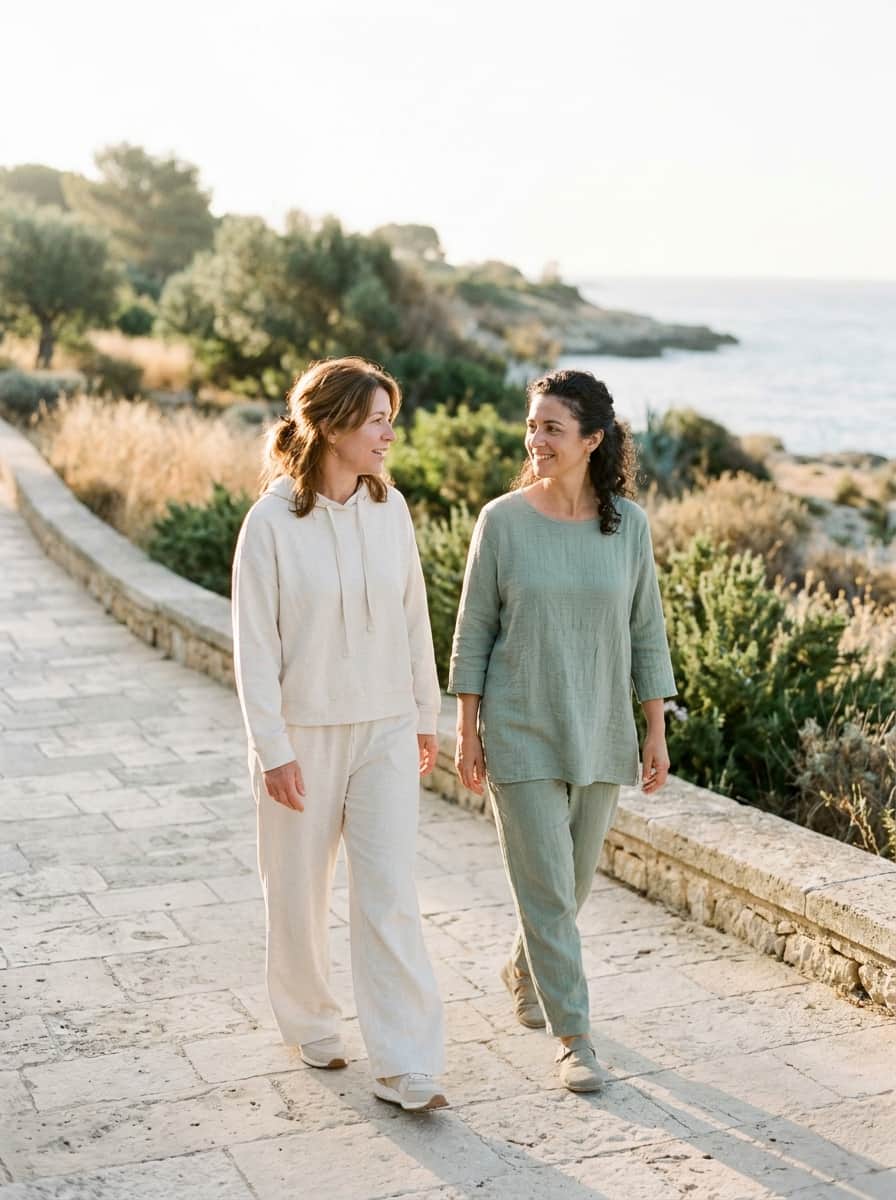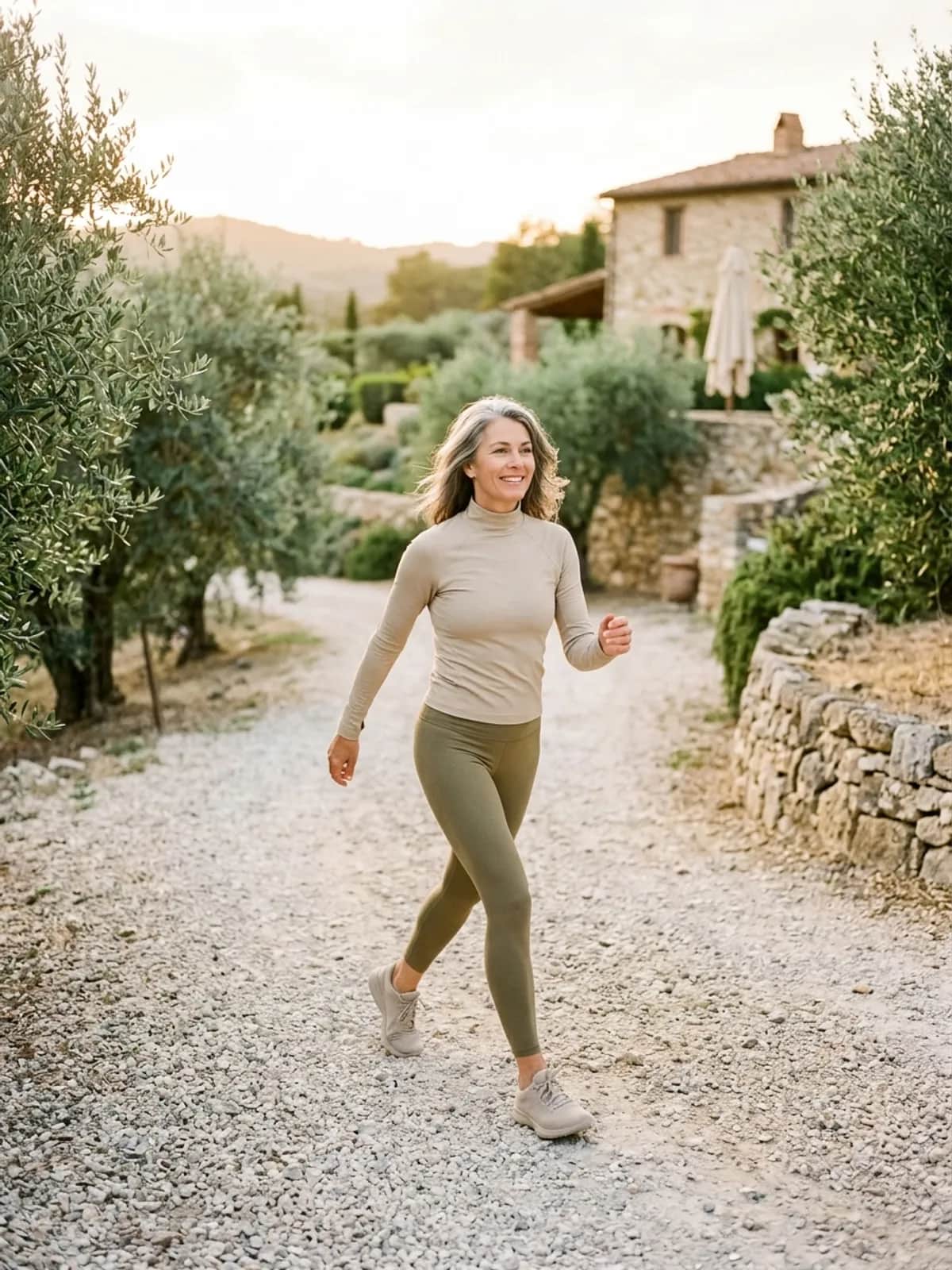
A japanese walking workout alternates 3 minutes of brisk walking (where talking gets a little harder) with 3 minutes of easy, relaxed walking, repeated for about 30 minutes total. The beauty of this simple 3+3 rhythm is that it travels with you: you can run the exact same intervals on an outdoor loop, on a treadmill by nudging the speed up and down, in place at home, on a hilly route, or in a shortened 18-minute version on a busy day. The effort pattern stays the same, only the setting changes.
Below you'll find five ready-to-use session formats, each with who it suits, how to set it up, the snag most people hit and a timer preset so you can press start and simply walk. After the formats comes the part most guides skip: how to combine them into a real week, including rainy weeks, busy weeks and travel weeks. If you want the research behind the method and the gentle week-by-week ramp for beginners, start with our pillar guide to the Japanese walking method and come back here for the session variety.
How the 3+3 structure works in any setting
Every format here uses the same core: brisk intervals that feel like a 6 or 7 out of 10 effort, and easy intervals that let your breath fully recover. The brisk block is where the work happens, the easy block is where you reset so you can hit the next brisk block with good form.
Three cues help in every environment:
- Brisk should feel purposeful. You can still speak, but in shorter sentences, and you could not sing.
- Easy should feel genuinely restful, not a half-hearted brisk. If you are still puffing at the end of an easy block, the brisk block before it was too hard.
- Posture stays tall through all five rounds, shoulders relaxed, eyes forward. Our guide to posture correction has simple cues if you tend to slump as you tire.
The talk test is what makes this method portable. A pace that is brisk on flat pavement might be too much on a hill and too little on a treadmill belt, but your breathing tells you the truth in every setting. Judge effort by breath, not by speed, steps or the number on a screen.
A simple timer removes the rest of the guesswork. Each format below links to our japanese walking timer with the intervals and rounds already filled in, so the settings travel with the link.
Which format fits you today?
Use this as a quick chooser. Most women end up using two or three formats regularly rather than all five.
| Format | Best for | Space or gear | Session length | Timer preset |
|---|---|---|---|---|
| Classic outdoor route | The standard session, fresh air | A flat loop or path | About 35 min with warm-up | 3 / 3 / 5 rounds |
| Treadmill speed intervals | Precise pacing, bad weather | Treadmill | About 35 min | 3 / 3 / 5 rounds |
| Indoor and at home | Small spaces, no machine | A hallway or a mat-sized spot | About 35 min | 3 / 3 / 5 rounds |
| Hill or incline intervals | More challenge without more speed | A gentle slope or incline setting | About 29 min | 3 / 3 / 4 rounds |
| Quick 18-minute version | Busy days, keeping the streak | Anywhere | About 21 min | 3 / 3 / 3 rounds |
Format 1: The classic outdoor route
This is the original and the one most people picture. Find a flat, uninterrupted stretch (a park loop, a quiet neighborhood block, a boardwalk, a school track) so you're not stopping at crossings during a brisk interval.
- Warm up with 3 minutes of easy walking
- Alternate 3 minutes brisk, 3 minutes easy, for 5 rounds
- Cool down with a few minutes of relaxed walking and gentle stretches
Who it suits: anyone who can walk 30 minutes comfortably and has a safe route. It is the closest to the walking that the original research participants did, so it makes a good "home base" session.
Route tips: a loop that takes about 6 minutes to walk at your mixed pace is ideal, because each round brings you back to your start point. That way you are never far from home if the weather turns or you feel off. A track is the most even surface; packed dirt and grass are softer on the joints but slightly less predictable underfoot; pavement is fine in cushioned shoes. Avoid uneven gravel for brisk blocks until your ankles are used to it.
The usual snag: traffic lights. A red light in the middle of a brisk block is fine (march in place until it changes), but a route with many crossings turns the session into stop and start walking. Pick the quieter route even if it is less scenic.
Preset: 3 min brisk / 3 min easy / 5 rounds. Supportive footwear makes a real difference outdoors, so it may be worth reviewing the best shoes for Japanese walking and daily walks.
Format 2: Treadmill speed intervals
A treadmill makes effort control precise because you set the exact pace instead of judging it. Keep the incline flat and change your brisk and easy efforts with speed alone.
| Phase | Example pace | Feel |
|---|---|---|
| Easy | 2.5 to 3.0 mph | Conversational, restful |
| Brisk | 3.5 to 4.2 mph | Purposeful, shorter sentences |
Adjust the actual numbers to your own fitness. The goal is a clear contrast between the two efforts, not a specific speed. Preset: 3 min brisk / 3 min easy / 5 rounds.
Who it suits: women who like structure, anyone walking in winter, heat or the dark, and anyone who finds it hard to judge "brisk" on their own. Once you know your two speeds, you can repeat the same session every time and see progress in the numbers.
How to set it up: spend your first treadmill session finding your speeds. Start at an easy pace, then raise it in small steps until you reach short sentences only. Note that speed as your brisk number. Your easy number is the pace where breathing settles within a minute.
Treadmill details that matter:
- Most treadmills take several seconds to speed up or slow down. Press the button when the timer chimes and accept that the change lags a little, or press it 10 seconds early if you prefer exact blocks.
- Walk without holding the rails if you can do so safely. Holding on takes load off your legs and makes the brisk block easier than it feels.
- Keep your stride natural. If you start to jog to keep up, the speed is too high for walking; lower it or add a small incline instead.
- Treadmill walking can feel easier than outdoor walking at the same speed, because there is no wind and the belt helps your stride. That is another reason to let the talk test decide.
The usual snag: watching the display. Put a towel over the screen and let the timer chime the changes.
Format 3: Indoor and at home
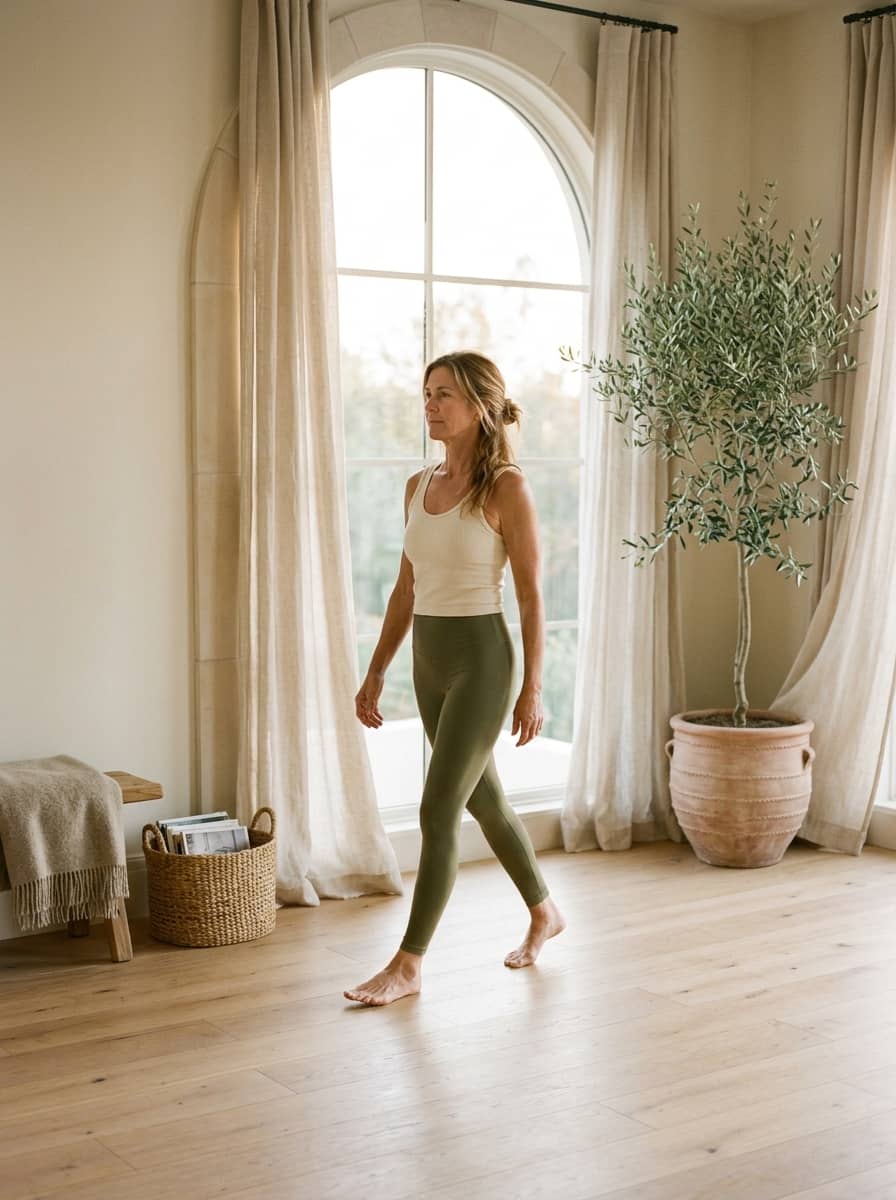
No treadmill and bad weather outside? You can march the 3+3 pattern in place or across a hallway and still get the benefit. Lift your knees a little higher during brisk blocks and add a gentle arm swing to raise your effort without needing floor space.
Who it suits: anyone in an apartment, caregivers who cannot leave the house, and anyone who feels self-conscious walking briskly in public while learning the rhythm.
How to make brisk feel brisk indoors: marching in place is gentler than walking forward, so add intensity in other ways. Lift your knees toward hip height, swing your arms from the shoulder with bent elbows, and quicken your feet. A hallway loop (walk to the end, turn, walk back) feels more like real walking. Some women alternate: march in place for the easy block and walk the hallway loop briskly.
Surfaces and shoes: wear shoes even at home. Hard floors are tough on bare feet over 30 minutes, and socks on wood are a slip risk. A rug or exercise mat softens the landing for marching.
Many people find a compact walking pad makes indoor sessions far easier to stick with, and the treadmill tips above apply to it as well.
Preset: 3 min brisk / 3 min easy / 5 rounds. For a short no-equipment option, pair this with our 10-minute walking workout at home, and if you want a full month of indoor sessions, the indoor walking challenge builds one week by week.
Format 4: Hill or incline intervals
Adding a gradient to your brisk blocks increases the challenge for your legs and heart without making you walk faster. This format suits anyone who finds flat walking too easy but wants to stay low-impact.
- Use a gentle outdoor slope, or set a treadmill incline for the brisk blocks
- Walk the brisk 3 minutes up or on incline
- Return to flat (or lower the incline) for the easy 3 minutes
Who it suits: women who have done several weeks of the classic format and find the brisk blocks no longer reach short sentences, even at their fastest comfortable walking pace. Hills raise effort without the jarring that comes from pushing your speed toward a jog.
How to set it up outdoors: find a slope that takes about 3 minutes to walk up. Walk up briskly, then turn and walk down slowly for the easy block. Downhill is easy on the heart but harder on the knees, so shorten your stride and keep the pace relaxed. If your hill is short, walk up and down it repeatedly for the brisk block and use the flat at the bottom for the easy block.
On a treadmill: keep the speed the same and raise the incline only for brisk blocks. Begin with a small incline and add a little each week if the talk test allows.
The usual snag: leaning forward and gripping the rails on a steep incline. If you have to hold on, the incline is too high.
Because inclines raise effort quickly, consider shortening to 4 rounds when you first try it. Preset: 3 min brisk / 3 min easy / 4 rounds.
Format 5: The quick 18-minute version
When your day is packed, a shorter session still counts. This version keeps three brisk intervals instead of five, so the intervals take 18 minutes, or about 21 with the warm-up.
- 3 min easy to start
- 3 min brisk / 3 min easy, repeated for 3 rounds
Who it suits: everyone, on the days a full session will not happen. The quick version protects your habit, and an unbroken habit matters more than any single workout.
How to use it well: do not try to make up for the shorter time by walking harder. Keep the same brisk effort, enjoy the shorter session, and keep at least three of your weekly interval days at the full five rounds, which is the dose the research tested.
Preset: 3 min brisk / 3 min easy / 3 rounds. Short sessions are a smart way to stay consistent on busy weeks, and consistency is what supports results over time. For a realistic look at outcomes, see Japanese walking for weight loss.
How to build a week from these formats
The research behind Japanese walking asked for intervals on four or more days a week. The formats are simply tools for getting those four days done. Here is how to combine them in different kinds of weeks. Our pillar guide has a general sample week; these are the format-specific versions.
A normal week: two classic outdoor routes, one treadmill or indoor session, and one hill session. Put the hill session after a rest or easy day, never the day after another hard session while you are new.
A rainy or winter week: two treadmill or walking pad sessions and two indoor hallway sessions. If you have no machine at all, make every session indoors and keep the knee lift and arm swing generous in brisk blocks so they still feel brisk.
A busy week: two full sessions on the days with the most time, and two quick 18-minute versions on the others. That still gives you four interval days.
A travel week: hotel hallways, airport walkways and a hotel gym treadmill all work. Save the timer link on your phone so the settings come with you.
On non-interval days, gentle movement or rest is fine. A short strength session such as our wall Pilates routine balances the walking well, and if you already own a light vest, the gentle weighted vest beginner plan makes a good strength day.
How to progress without getting hurt
Progress in this order, one change at a time, and only when last week felt comfortable and nothing hurt the next morning:
- Finish every round. If five rounds is not yet comfortable, use shorter brisk blocks first, following the ramp in the Japanese walking method guide.
- Add variety. Bring in the treadmill or hill format before anything else.
- Add terrain. Gentle hills or a little incline in brisk blocks.
- Consider load last. Much later, and only if you want it, a light vest worn on easy intervals or easy days only, as explained in Japanese walking with a weighted vest. Add time before weight, always.
Not yet walking 20 minutes comfortably? Build the base with the 30-day walking challenge first, then come back to these formats.
Common mistakes with interval walking formats
- Making every session a hill session. Hills are a spice, not the main dish. Once a week is plenty while you build up.
- Turning brisk into a jog. Walking means one foot is always on the ground. If you start to bounce, slow down or add incline.
- Easy blocks that are not easy. The recovery is part of the method. Slow down until breathing settles.
- Choosing a route full of stops. Pick the boring, uninterrupted loop for your interval days and save the scenic route for easy walks.
- Skipping the warm-up on cold mornings. Three easy minutes before the first brisk block helps your joints and makes the first interval feel better.
Who should check with a doctor first
Interval walking is gentle, but the brisk blocks do raise your heart rate, and hills raise it faster. If you have a heart condition, high blood pressure, joint concerns or you're returning from an injury, check in with a healthcare professional before starting a new routine, and start with shorter brisk blocks rather than the full 3 minutes.
Frequently Asked Questions
How long is a Japanese walking workout?
The standard session is five rounds of 3 minutes brisk and 3 minutes easy, which is 30 minutes of intervals plus a short warm-up and cool-down. On busy days, three rounds (18 minutes of intervals) still keeps the habit going.
Can I do Japanese walking on a treadmill?
Yes. Raise the speed for the brisk blocks and lower it for the easy ones, or add a small incline to the brisk blocks. Let the talk test, not the number on the display, decide what brisk means for you, and avoid holding the rails if you can walk safely without them.
Can I do Japanese walking at home without a treadmill?
Yes. March in place or walk a hallway loop, lifting your knees a little higher and swinging your arms harder during the brisk blocks. The timer works the same way indoors.
How many times a week should I do these workouts?
The original research asked for four or more interval days a week. You can mix the formats across those days, for example two outdoor routes, one treadmill session and one hill session.
Is walking uphill better than walking faster?
Neither is better, they are two ways to raise effort. Hills let you work harder without breaking into a jog, which many women find kinder on the joints. Use speed on flat days and incline on one challenge day a week.
Can I mix formats in one session?
Yes. A common mix is warming up outdoors and finishing on a treadmill, or walking brisk blocks up a hill and easy blocks on the flat. Keep the 3+3 timing the same and the session counts.
The Bottom Line
The japanese walking workout is one adaptable formula: 3 minutes brisk, 3 minutes easy, repeated for about 30 minutes (or 18 minutes when you're short on time). Whether you take it outdoors, onto a treadmill, into your living room, up a hill, or into a quick version, the effort pattern stays the same and the timer does the thinking. Use the formats to get four interval days done in any kind of week, progress one change at a time, and let the talk test set your pace. For more ways to move gently and consistently, explore our exercise section.