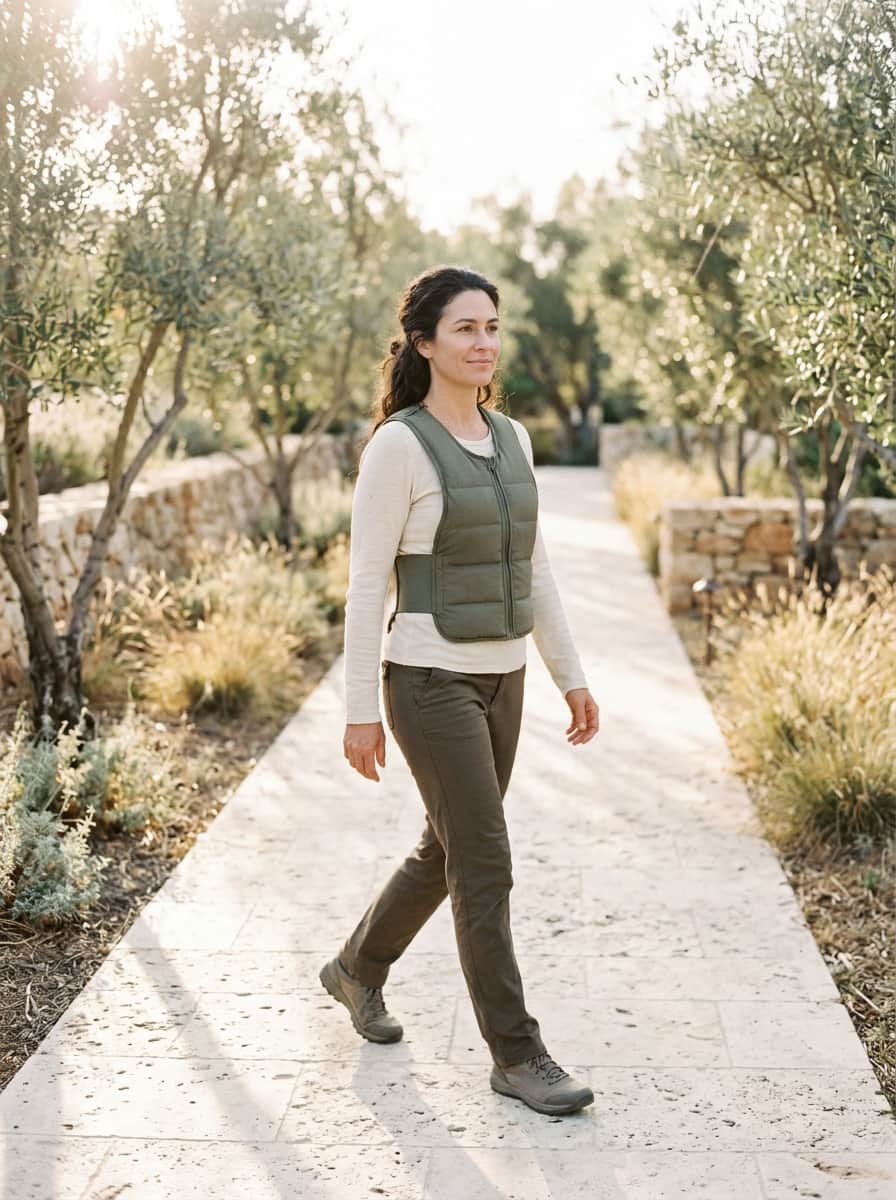
A weighted vest adds gentle load to walking, chores and simple bodyweight moves. The realistic weighted vest benefits for women are a little more effort from the same walk, a modest increase in calorie burn, more strength demand for your legs and postural muscles, and an easy way to progress without buying heavier dumbbells. The big promises, especially about rebuilding bone, are much less certain than social media suggests. Start at about 5 percent of your body weight or less, build slowly, rarely go above about 10 percent for walking, and check with your doctor first if you have joint, back, bone or pregnancy concerns.
This guide is the hub for everything we have written about vests: what a vest does, what the research honestly supports, who should be careful, how to choose a starting load, what good fit feels like, and how a vest fits with walking, home strength work and Japanese interval walking. Each section points you to a deeper guide when you are ready for it.
What a weighted vest actually does
A vest spreads extra load across your torso, so your legs, hips, core and heart work a little harder to do the same movement. Because the weight sits close to your center of gravity, it changes your natural stride far less than weight strapped to your ankles or wrists.
That placement is the key difference from the ankle and wrist weights we cover elsewhere. Weight on a limb sits at the end of a moving lever, which can strain ankles, knees, elbows and shoulders, and is why we keep ankle weights for walking at 1 to 2 lb. A vest simply makes you a little heavier, which lets you add more total load with less change to how you move.
Common reasons women reach for a vest
- Getting more out of a daily walk without walking faster or longer
- Progressing bodyweight moves like squats to a chair, step-ups and marches
- Keeping strength work low-impact, with no jumping or heavy lifting
- A grab-and-go way to make ordinary movement count a little more
What does the research say about weighted vest benefits?
Here is where honest framing matters, because vests are marketed with far more confidence than the evidence supports.
| Claim you will see | What the evidence supports |
|---|---|
| "Burns more calories" | Yes, modestly. Carrying extra load raises the energy cost of walking roughly in line with the added weight, so a light vest adds a small amount, not a dramatic one. |
| "Builds strength" | Partly. A light vest adds some challenge for legs and posture, especially for beginners, but it is not a replacement for progressive strength training. |
| "Reverses osteoporosis" | No. Studies are small and mixed, often combine vests with other exercise, and recent trials in older adults have not shown that wearing a vest on its own protects bone density. |
| "Melts belly fat" | No. Spot reduction does not happen, and a vest is a small helper for weight management, not a fat-loss device. |
| "Improves balance" | Unclear. A vest changes how you move and can make balance harder, which is why balance concerns are on the caution list below. |
The bone question deserves a direct answer. Weight-bearing and resistance exercise in general are part of most bone-health advice, and a vest is one way to add load to weight-bearing movement. But no vest can promise to increase or protect your bone density, and if you have osteoporosis or low bone density, added load should be planned with your doctor or a physical therapist, not guessed.
For weight management, the same honesty applies as with ankle weights and weight loss. Movement, nutrition, sleep and consistency do the heavy lifting. A vest just makes the movement part a little more demanding.
Who should be careful with a weighted vest?
A vest is not right for everyone, and waiting is a perfectly good decision. Talk with a qualified healthcare professional before starting if any of these apply to you.
| Situation | Why to be cautious |
|---|---|
| Osteoporosis or low bone density | Added load, and the risk of a fall, need professional guidance |
| Back, hip or knee pain | Extra weight can increase strain on sensitive joints |
| Pregnancy or recent birth | Load, balance and overheating need professional input, similar to our guidance on ankle weights while pregnant |
| Heart or blood pressure conditions | Added intensity should be cleared first |
| Recent surgery or active injury | Rehab needs are individual; see weights for physical therapy |
| Balance concerns or a history of falls | A vest shifts how you move and can affect stability |
| Pelvic floor symptoms | Extra load can make leaking or heaviness worse; ask a pelvic health physiotherapist |
If you get the green light, start lighter and slower than you think you need. There is no prize for rushing.
How heavy should a weighted vest be for a beginner?
Our rule for vests mirrors our conservative approach to how much weight ankle weights should be: begin light, progress slowly and let comfort lead. All of our vest guides use the same numbers:
- Start at about 5 percent of your body weight or less. Many beginners do well at 4 to 8 lb.
- Add time before you add weight. Longer, comfortable walks come first.
- Increase in small steps, 1 to 2 lb at a time, and only when the current load feels easy for a couple of weeks.
- For walking, rarely go above about 10 percent of body weight. Heavier vests belong to dedicated strength work, if at all.
| Your body weight | Starting load (about 5% or less) | Walking ceiling (about 10%) |
|---|---|---|
| 140 lb | 4 to 7 lb | 14 lb |
| 160 lb | 4 to 8 lb | 16 lb |
| 180 lb | 5 to 9 lb | 18 lb |
| 200 lb | 6 to 10 lb | 20 lb |
| 240 lb | 8 to 12 lb | 24 lb |
The ceiling is a limit, not a goal. Plenty of women stay at 6 to 10 lb for good because that is what feels right on their back and knees, and that is a perfectly good outcome. Adjustable vests with removable weight packs make this gradual approach far easier than a fixed-weight vest.
A simple first month
- Weeks 1 and 2: wear the vest for short, easy walks of 10 to 20 minutes. Notice how your back, hips and knees feel the next morning.
- Weeks 3 and 4: if you feel good, lengthen the walks or add a few gentle bodyweight moves at home.
- After a month: consider a small weight increase, one step at a time, never doubling up.
If anything aches the next day beyond normal tired muscles, go back a step. Neck and shoulder tension usually means the vest is too heavy or sits too low; lower back ache usually means too heavy or too long.
What makes a weighted vest fit well?
A vest that bounces or digs in will ruin an otherwise good walk, and a vest that shifts can throw off your stride. Fit matters more than price.
- Snug but breathable: it should stay put without squeezing your ribs or restricting a deep breath.
- Shaped for a female torso: shorter length, comfortable strap placement around the chest, and a cut that sits above the hips.
- Even weight pockets: balanced front and back loading protects your posture and stops the vest pulling forward.
- Adjustable side straps: long enough to close properly, so the vest does not ride up.
- Easy on and off: you are more likely to use a vest that is not a struggle to secure.
If straps are the problem on most vests you try, look for listings that state larger sizing and keep strap extenders in mind. We cover that in detail in weighted vests for plus-size women.
Which weighted vest is right for your goal?
Different goals call for different vests. This is the quickest way to decide which of our buying guides to open.
| Your main goal | What to look for | Where to look |
|---|---|---|
| Daily walks | Light, low-bounce, breathable, about 6 to 12 lb | Best weighted vests for walking |
| Walking plus home strength work | Adjustable packs so you can start light and progress | Best weighted vests for women |
| Comfortable fit on a fuller figure | Long straps, U-neck cut, stated larger sizing | Weighted vests for plus-size women |
Walking with a weighted vest
Walking is where most women start, and it is the most forgiving way to use a vest. Keep your pace comfortable, your posture tall and your route flat and familiar for the first weeks. Wear supportive shoes; the extra load makes poor footwear show up faster, which is one reason we flag the best shoes for Japanese walking and everyday brisk walks.
For a walking vest, light and secure beats heavy. We compare low-bounce options in the best weighted vests for walking.
Japanese walking with a weighted vest
If you already follow the Japanese walking method, with 3 minutes brisk and 3 minutes easy for five rounds, a vest can be a later progression. The key is order: learn the intervals without load first, then wear the vest on easy walks and easy intervals, and keep your brisk blocks vest-free until you are well adapted. The brisk blocks are already where effort and impact peak, so adding weight there stacks two stressors at once.
We explain exactly when it makes sense, and a step-by-step progression, in Japanese walking with a weighted vest. For session variety without a vest, see the five Japanese walking workout formats.
Strength work at home with a vest
A light vest also turns simple bodyweight moves into a gentle strength session: squats to a chair, step-ups, wall push-ups, marching and short carries. Two or three short sessions a week, with a rest day in between, suits most beginners. Our gentle weighted vest beginner plan at home gives you timings, form cues and a six-week progression.
Prefer to build a base without any load first? The 10-minute walking workout at home and our wall Pilates routine are good places to start, and the vest will still be there when you feel ready.
Weighted vest vs ankle or wrist weights
All three add load, but they do it in different places, which changes who they suit.
| Weighted vest | Ankle weights | Wrist weights | |
|---|---|---|---|
| Where the load sits | Torso, near your center of gravity | End of the leg | End of the arm |
| Effect on your stride | Small | Can change your gait | Can stiffen your arm swing |
| Typical walking load | About 5 to 10% of body weight | 1 to 2 lb per ankle | 1 to 2 lb per wrist |
| Best for | Adding total load to walks | Floor work and gentle leg strength | Light upper-body add-on |
If you want to compare further, read whether wrist weights are safe for walking and ankle weights for beginners.
Will a weighted vest help with weight loss?
A little, as part of a bigger routine. A vest raises the energy cost of a walk modestly, and over many walks that adds up, but it will not offset eating patterns, poor sleep or stress, and it does not target fat in any particular place. The same honest framing applies to walking itself, as we explain in Japanese walking for weight loss: what it can and can't do. Think of the vest as a small progression tool for an already steady habit.
Where to start, one step at a time
- Check the caution list above. If anything applies, talk to your doctor or physical therapist first.
- Build the walking habit without load. A few weeks of regular walking, or the Japanese walking method, comes before any vest.
- Pick your goal and your vest. Walking, home strength or plus-size fit: open the matching guide from the table above.
- Start at about 5 percent of body weight or less on short, easy walks, and add time before weight.
- Add a home session when you are ready, using the beginner vest plan.
The Bottom Line
The real weighted vest benefits for women are practical: a convenient, joint-friendly way to add a little load to walks and simple movements, with a modest boost to effort, strength demand and calorie burn. Be skeptical of big bone-density and fat-loss promises. Start at about 5 percent of body weight or less, prioritize a secure fit, add time before weight, keep walking loads at or below about 10 percent, and check with your doctor first if you have joint, back, bone or pregnancy concerns. Used that way, a vest can be a sustainable addition to the movement you already enjoy.
Frequently Asked Questions
What are the main benefits of a weighted vest for women?
A vest makes walking and bodyweight moves a little more demanding, which can modestly raise calorie burn and strength demand for your legs and posture. It is also an easy way to progress without buying heavier weights. Claims about reversing bone loss or burning belly fat are not supported.
How heavy should my first weighted vest be?
Start at about 5 percent of your body weight or less; for many women that is 4 to 8 lb. Add time before weight, increase in 1 to 2 lb steps, and for walking rarely go above about 10 percent of your body weight.
Does a weighted vest help with osteoporosis?
It has not been shown to. Studies are small and mixed, and wearing a vest on its own has not been shown to protect bone density. If you have osteoporosis or low bone density, plan any added load with your doctor or a physical therapist.
How long should I wear a weighted vest each day?
Start with 10 to 20 minutes on easy walks a few times a week. If your back, hips and knees feel fine the next day, lengthen the walks gradually before you add any weight.
Can I wear a weighted vest for Japanese walking?
Yes, once the method feels comfortable without load. Wear it on easy walks and easy intervals first, and keep your brisk blocks vest-free until you are well adapted.
Is a weighted vest better than ankle weights for walking?
For walking, usually yes. A vest keeps the load near your center of gravity, so it changes your stride less than ankle weights, which is why we keep ankle weights for walking at just 1 to 2 lb.