Wall Pilates is Pilates-style strength and mobility work that uses a wall as a prop: you lean, press or rest your feet against it. The wall gives you support and instant feedback on alignment, so it suits busy people who want a short, home-based session without equipment. Five moves are enough for a complete 15-minute routine that fits into a lunch break or the gap before dinner.
Below you will find each move with form cues and easier or harder options, a minute-by-minute timing table, notes for sensitive knees and wrists, and a simple way to progress over a month.
Why the Wall Helps Beginners
- Feedback. When your back is against the wall, you can feel whether your spine is rolling evenly or your shoulders are lifting. The same feedback is behind the wall angels in our posture correction routine.
- Support. Leaning into the wall takes part of your body weight, so moves like push-ups and planks are easier to learn with good form.
- Fewer floor transitions. Four of the five moves are done standing. That matters if getting down to the floor and back up is not your favourite part of exercise.
- No equipment. A clear stretch of wall and a non-slip floor or mat is all you need.
What it does not do: wall Pilates on its own is not a cardio workout, and it does not replace heavier strength training if that is your goal. It is a realistic way to move every few days when time is short. For the cardio side, pair it with a walking plan such as our 30-day walking challenge or the brisk intervals of the Japanese walking method.
Before You Start
- Find a clear section of wall at least as wide as your arm span, with no pictures or shelves nearby.
- Wear socks with grip or go barefoot on a mat. Plain socks on a hard floor slide.
- Warm up for one minute: march on the spot, roll your shoulders and circle your arms.
The 5 Wall Pilates Moves
1. Wall roll-down
Stand with your back against the wall, feet hip-width apart and about a foot in front of it, knees softly bent. Exhale and nod your chin toward your chest, then peel your spine off the wall one section at a time until you hang forward, arms loose. Inhale at the bottom. Exhale and roll back up, pressing each part of your back into the wall in turn.
- Cue: keep your hips touching the wall the whole time.
- Easier: roll down only to the bottom of your shoulder blades.
- Harder: slow down to 5 seconds down and 5 seconds up.
- Skip or keep it shallow if: you have osteoporosis or low bone density, since deep forward rounding is best avoided.
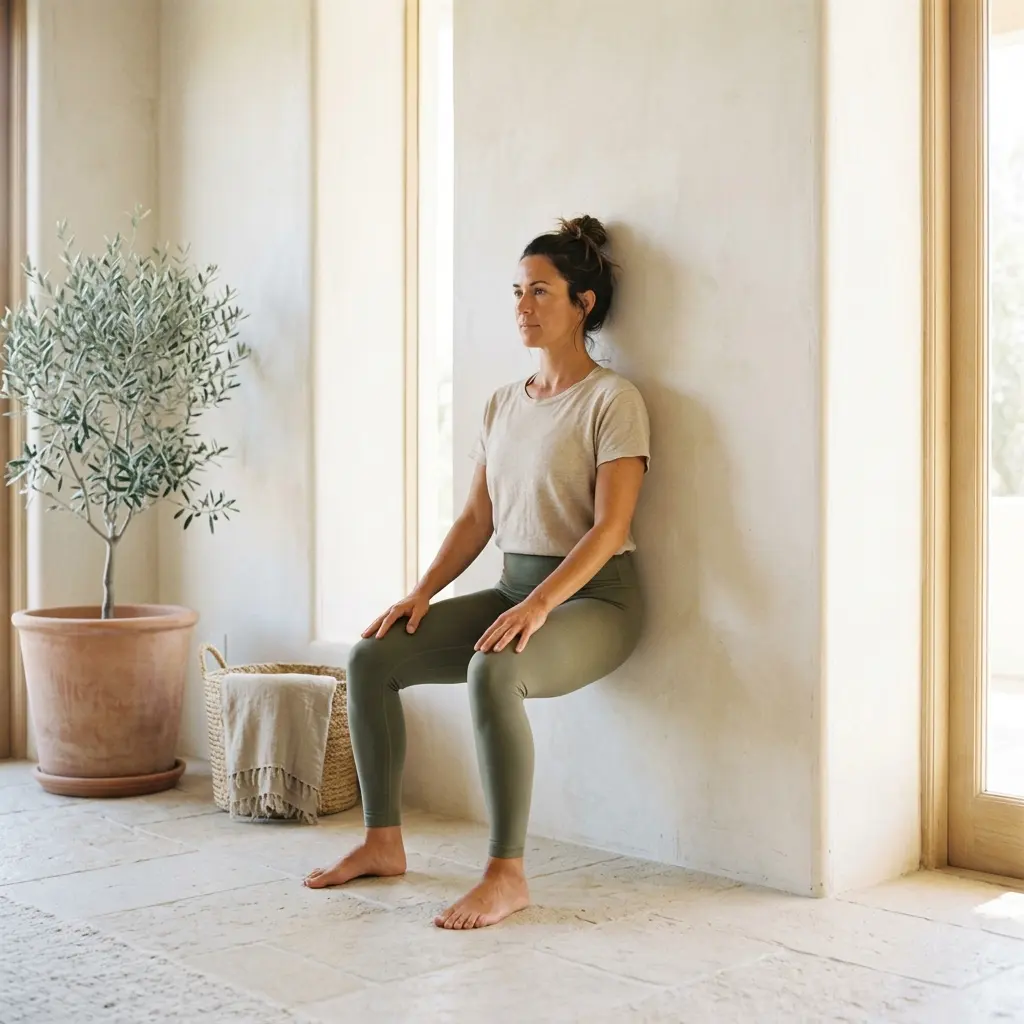
2. Wall sit
Back against the wall, walk your feet forward and slide down until your knees are bent, as if sitting on a high chair. Hold, breathing steadily, then slide back up.
- Cue: knees over the ankles, not past the toes, and weight in the heels.
- Easier: a shallow sit, knees bent about halfway. This is where most beginners should start.
- Harder: thighs closer to parallel with the floor, or lift one heel at a time.
- Knees: if they ache, stay higher and shorten the hold. Pain at the kneecap means you are too deep.
3. Wall push-up
Stand an arm's length from the wall and place your palms flat on it at shoulder height, slightly wider than your shoulders. Bend your elbows to bring your chest toward the wall, keeping a straight line from head to heels, then press back.
- Cue: elbows angle back at about 45 degrees, not straight out to the sides.
- Easier: stand closer to the wall.
- Harder: step your feet farther back, or lower for 3 seconds.
- Wrists: if they complain, put your hands a little lower on the wall or make soft fists against it.
4. Wall plank
Face the wall and place your forearms on it, elbows under your shoulders. Walk your feet back until your body makes a straight diagonal line. Hold, breathing steadily.
- Cue: gently draw your belly in and keep your ribs from flaring.
- Easier: feet closer to the wall.
- Harder: walk the feet farther back, or lift one heel at a time.
- Wrists: the forearm position keeps weight off the wrists, which makes this a good alternative to a floor plank.
5. Wall leg slides
Lie on your back with your hips about a foot from the wall and your feet on the wall, knees bent at roughly a right angle. Press your lower back gently toward the floor. Slowly slide one foot up the wall until the leg is nearly straight, then slide it back. Alternate legs.
- Cue: keep the pelvis still; the leg moves, the hips do not rock.
- Easier: smaller slides.
- Harder: lift your hips into a low bridge with both feet on the wall and slide one foot at a time.
The 15-Minute Routine: Timing Table
| Minute | Move | Work | Rest | Easier option | Harder option |
|---|---|---|---|---|---|
| 0 to 1 | Warm-up | March, shoulder rolls, arm circles | None | Seated arm circles | Add gentle knee lifts |
| 1 to 3 | Wall roll-down | 5 slow reps | Breathe at the bottom | Roll to shoulder blades only | 5 seconds each way |
| 3 to 6 | Wall sit | 3 x 30 seconds | 30 seconds | Shallow sit, 20 seconds | Deeper sit, 45 seconds |
| 6 to 9 | Wall push-up | 3 x 8 to 10 reps | 30 seconds | Stand closer | Feet farther back |
| 9 to 12 | Wall plank | 3 x 20 to 30 seconds | 30 seconds | Feet closer | Heel lifts |
| 12 to 14 | Wall leg slides | 8 per leg | As needed | Smaller slides | From a low bridge |
| 14 to 15 | Cool-down | 2 roll-downs and 3 slow breaths | None | Stay upright, just breathe | Hold the bottom for 3 breaths |
How to Progress Over 4 Weeks
- Week 1: two sessions, easier options throughout. Learn the cues.
- Week 2: two or three sessions. Use the standard version of each move.
- Week 3: add 5 to 10 seconds to each hold, or 2 reps to the push-ups and slides.
- Week 4: try the harder option on one or two moves you find easiest.
Change one thing at a time. If you want more leg and glute work later, light ankle weights can be added to the leg slides; our guide to ankle weight exercises for glutes and legs shows how to start, and the free ankle weight calculator suggests a sensible starting weight. Prefer to add load through your whole body instead? A light vest turns squats, step-ups and wall push-ups into a gentle strength session, as in our weighted vest beginner plan at home.
Making 15 Minutes Happen on Busy Days
- Book it. Put it in your calendar like a short meeting, at the same time on the same days. Our guide to reducing stress at work has more ideas for protecting short breaks in a full diary.
- Keep the gear visible. A rolled mat by the wall is a reminder.
- Have a 5-minute version. On packed days do just the wall sit, push-up and plank, one round each. Something counts. Our quick exercises for busy days offer more 3 to 10 minute options.
- Pair it. Do the routine right after a habit you already have, such as your afternoon tea.
On days you are stuck at a desk, a 2-minute round of desk yoga poses is an easy in-between option. And if you want to work more slowly on body awareness, somatic Pilates for beginners pairs well with this routine. Once the wall feels easy, Pilates board exercises add sliding resistance, and functional fitness moves for daily life carry the strength into chores.
Do You Need Any Equipment?
No. The routine is designed for a wall and a floor. A non-slip mat helps for the leg slides and keeps your feet from sliding in the wall sit; a thinner, grippy mat works better here than thick foam. Our yoga mat guide explains the difference.
If you have a knee, hip or shoulder condition, high blood pressure, or are pregnant, check with your doctor or a physical therapist about which moves suit you.
Frequently Asked Questions
Is wall Pilates good for beginners?
Yes. The wall supports part of your body weight and gives feedback on alignment, which makes moves like push-ups and planks easier to learn well. Start with the easier options and shorter holds, then build up over a few weeks.
Can 15 minutes of wall Pilates make a difference?
Fifteen minutes two or three times a week is a realistic way to keep your muscles working and break up long sitting days. It will not replace all other exercise, but done consistently alongside daily walking, it is a solid foundation.
Is wall Pilates safe for bad knees?
Often, with adjustments. Keep the wall sit shallow and short, and stop if you feel pain at the kneecap. The push-up, plank and leg slides put little load on the knees. If you have a diagnosed knee condition, ask your physical therapist which depth is right for you.
How many times a week should I do wall Pilates?
Two or three times a week, with a rest day between, is a good start. Once the routine feels easy, you can add a session or make the moves harder rather than making each session longer.
Do I need a special Pilates wall or bar?
No. Any sturdy, clear wall works. Some people like a mat for the floor exercise and grippy socks for the standing moves, but no special equipment is needed.