When you purchase through links on our site, we may earn an affiliate commission. Here's how it works.
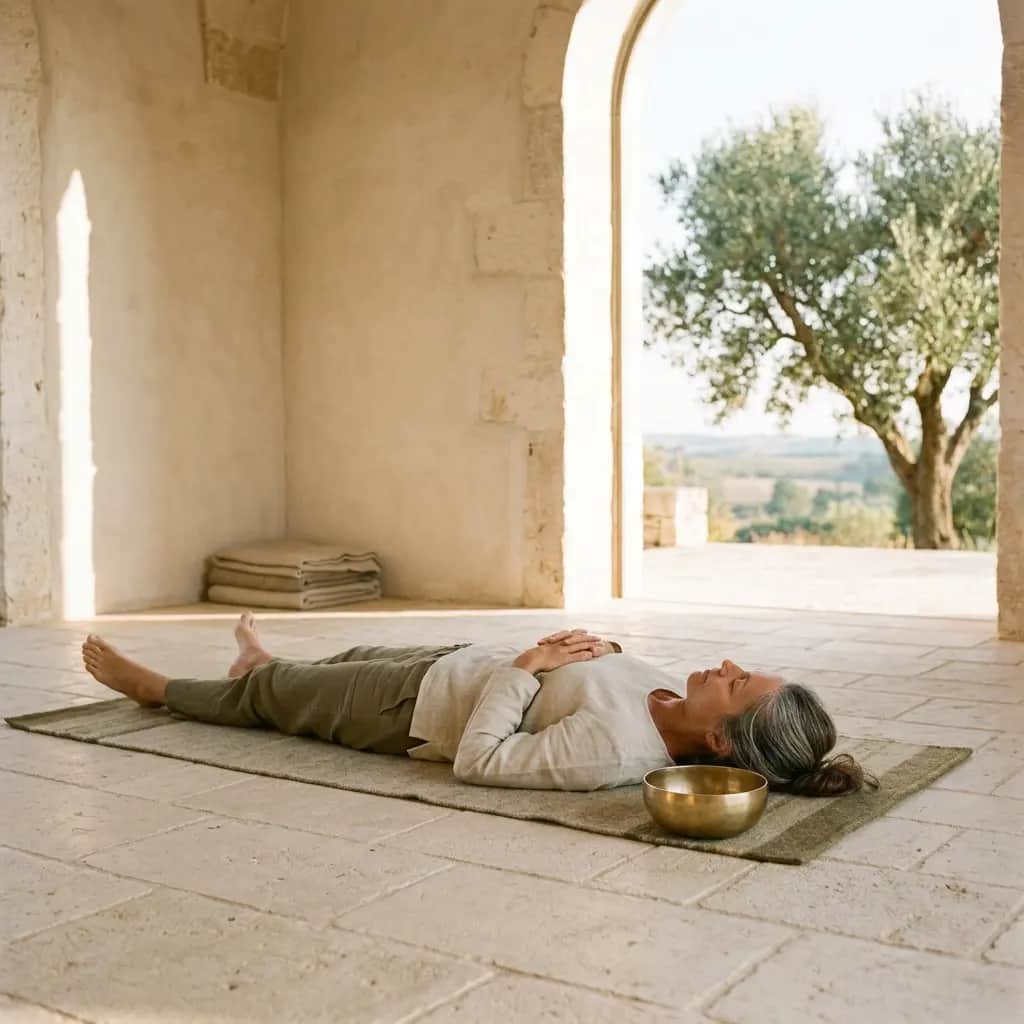
Yoga nidra is done lying on your back for 20 to 40 minutes, so the props that matter are the ones that keep you comfortable while lying still: a cushioned surface, support under the knees, a warm cover and something to shade the eyes. You can start with what is already in your home; buy something only when a specific discomfort keeps pulling you out of the practice.
Many product lists for yoga nidra show seated meditation cushions, which miss the point: you are not sitting. Below we match each real need to a pick, a free alternative and the honest downside. If you are new to the practice itself, start with our beginner's guide to yoga nidra, which includes a 20-minute script you can record.
Quick picks: what each prop solves
| Need | Why it matters lying down | Our pick | Free alternative |
|---|---|---|---|
| Cushioning under the back | A thin mat on a hard floor makes hips and shoulder blades ache after 15 minutes | Retrospec Solana Yoga Mat | Carpet plus a folded duvet |
| Support under the knees | Bent knees take strain off the lower back | Hihealer Meditation Cushion | Two pillows or a rolled blanket |
| A warm cover | The body cools as it relaxes; feeling cold pulls you out | Bazaar Anatolia Turkish Towel as a light cover | Any blanket and a pair of socks |
| Gentle weight (optional) | Some people find pressure settling | yescool Weighted Blanket | A heavy duvet folded in half |
| Eye cover | Light behind the eyelids keeps the mind busy | No pick, see below | A folded scarf or sleep mask |
How to set up in four steps
- Choose the floor or the bed. The floor keeps you a little more alert, which suits daytime practice. The bed is fine at night, when falling asleep is a welcome outcome and the session can slot into your sleep hygiene routine.
- Lay down the cushioning. Mat, carpet or folded duvet. You want your shoulder blades and the back of your pelvis to feel no hard spots.
- Support the knees. Slide a cushion or rolled blanket under the backs of your knees until your lower back softens toward the floor. If your back still aches, bend your knees and put your feet flat.
- Cover up before you start. Blanket over you, socks on, eye cover within reach. Reaching for a blanket halfway through breaks the relaxation more than anything else.
Total time: about two minutes once you know where everything lives. Keep the props in one basket so setting up never becomes the reason you skip a session.
Retrospec Solana Yoga Mat: for practicing on a hard floor
Why this pick: It is a thick foam mat rather than a thin sticky yoga mat, and for lying still, thickness matters far more than grip. On wood or tile it is the single prop most likely to make the difference between a comfortable session and a distracted one.
Who it suits: Anyone practicing on a hard floor, and anyone with bony hips or a sensitive tailbone. It also doubles as a mat for gentle floor exercise and stretching, such as a short somatic Pilates routine.
Downside: Soft, thick mats feel unstable in standing yoga poses such as balances, so if you also want a mat for an active flow class, this is not the one. Our guide to the best yoga mat for upward-facing dog explains the grip versus cushioning trade-off. Thick foam is also bulkier to roll and store.
If you want something slightly firmer that still cushions, the Gaiam Essentials Thick Yoga Mat is a similar style.
Hihealer Meditation Cushion: as a knee support
Why this pick: This is a round buckwheat-filled cushion with a removable velvet cover, sold for seated meditation. For yoga nidra we suggest using it differently: under the knees. Buckwheat hulls shift and hold their shape, so it molds into the space behind your knees better than a springy pillow, and you can still sit on it for a few minutes of breathing before you lie down. A breathing pacer is a simple way to time those first slow breaths.
Who it suits: People whose lower back aches when their legs are straight, and anyone who wants one cushion for both seated meditation and lying practice.
Downside: It is round, not long, so it supports the knees but not the full length of the thighs the way a proper yoga bolster would. Buckwheat is also heavier than foam and makes a soft rustling sound when you move. If you only ever practice lying down, two firm pillows may do the job just as well.
The Gaiam Zafu Meditation Cushion is a similar buckwheat option if you prefer that brand.
Bazaar Anatolia Turkish Towel: a light cover for warm rooms
Why this pick: A large, thin cotton towel (about 71 by 39 inches) is enough of a cover when the room is warm but you still cool down as you relax. It packs small, washes easily, and can be rolled into a neck or knee support when you need one.
Who it suits: Summer practice, warm apartments, travel, and people who overheat under a regular blanket.
Downside: It is a towel, not a blanket. In a cool room it will not keep you warm enough, and you will want a proper throw instead. We list it as a budget, multi-use option, not a must-have.
yescool Weighted Blanket: optional, and not for everyone
Why this pick: Some people find the even pressure of a weighted blanket settling, and a guided rest practice is a natural time to use one. This one is 20 lb.
Who it suits: Larger adults who already know they like the feeling of weight. Makers generally size weighted blankets by body weight, so check the seller's sizing guide before choosing a weight.
Downside: 20 lb is heavy. It is too much for many smaller adults, it can feel warm, and it is not suitable for children, for anyone who cannot easily move it off themselves, or for people with breathing, circulation or mobility problems unless their doctor agrees. Try a heavy duvet folded in half first: if that feels good, a weighted blanket may be worth it.
What about eye pillows and bolsters?
Both are classic yoga nidra props, and both are easy to improvise, which is why we do not push a specific product here.
- Eye cover: A folded soft scarf or any sleep mask works. A small eye pillow filled with flax seed adds light pressure some people enjoy. Avoid anything heavy pressing on the eyeballs.
- Bolster: A long, firm cylinder under the knees is the gold standard in restorative yoga classes. At home, a firm couch cushion or a tightly rolled blanket held with two hair ties does nearly the same job.
What you can skip
Singing bowls, special incense, crystals and dedicated "nidra" clothing are all optional extras. Bowls belong more to a sound bath meditation than to nidra. None of them changes what yoga nidra asks of you, which is simply to lie comfortably and listen. Spend on comfort first; if your back, hips or temperature are fine, you may not need to buy anything at all.
For more on the audio side, our guided sleep meditation guide explains how to choose recordings, what meditation music does helps if you like a soft background track, and the mindfulness techniques for better rest cover other lying-down practices. If you practice in the evening to unwind, pair it with our wind-down to lower cortisol for sleep. More calm practices live in our meditation and relaxation section.
Frequently Asked Questions
Do I need a meditation cushion for yoga nidra?
Not for sitting, because yoga nidra is done lying down. A firm cushion is useful under the knees to ease the lower back, but two pillows or a rolled blanket do the same job. Buy one only if you also meditate seated or your pillows keep collapsing.
Is a regular yoga mat thick enough?
On carpet, usually yes. On wood, tile or concrete, a standard thin mat often leaves the hips and shoulder blades aching after 15 to 20 minutes. A thicker foam mat, or a regular mat with a folded duvet on top, solves that.
Should I use a weighted blanket during yoga nidra?
Only if you already know you like the feeling and can easily move it off yourself. Many people do fine with an ordinary blanket. If you have breathing, circulation or mobility concerns, check with your doctor before using one.
Why do I get cold during yoga nidra?
When you lie still for a while you are not generating the warmth that movement does, so many people start to feel cool partway through a session. Put on socks and a cover before you start rather than halfway through.
Can I do yoga nidra in bed instead of on the floor?
Yes. In bed you are more likely to fall asleep, which is ideal at night and less ideal in the afternoon. For daytime sessions, the floor or a sofa tends to keep you aware for longer.