When you buy through links on our site, we may earn an affiliate commission. Here's how it works.
Pilates board exercises are core and full-body moves done on a foldable home board, usually with two pads that slide along tracks plus handles and resistance bands. The board is not a studio reformer: there is no moving carriage or springs, so the resistance comes from your own body weight, the friction of the sliding pads and the bands. For beginners, that means slow, short slides done with control, not the advanced reformer moves you see in studio videos.
This guide explains what you are actually working with, how it compares with a mat and a reformer, seven beginner-friendly exercises with cues, and a three-week plan. If you do not own a board, you can do most of these moves with two small towels on a smooth floor.
What Is a Pilates Board?
The name causes confusion because it is used for two very different things:
- Foldable home Pilates boards (sometimes sold as "multifunctional ab boards"). A flat platform you put on the floor, typically with two sliding pads on tracks, push-up handles and clips for resistance bands. This is what most people buy online for home use, and it is what this guide covers.
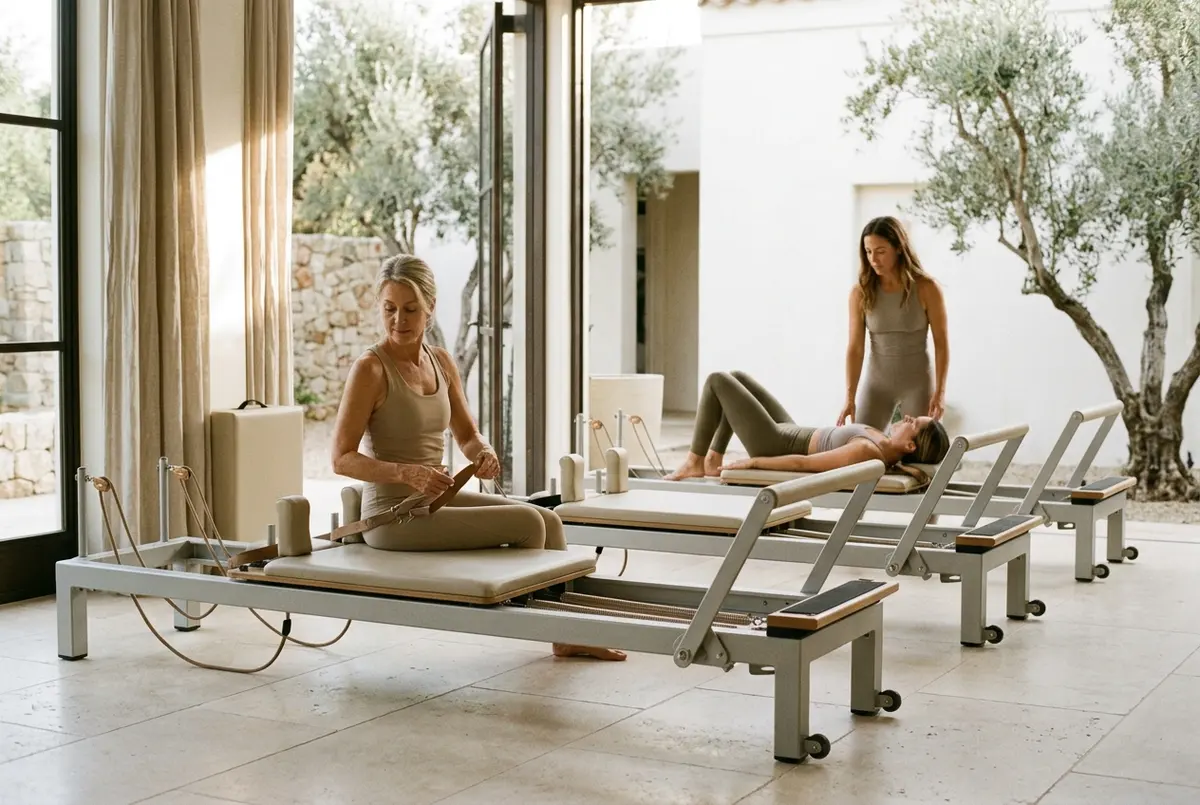
- Reformers. Studio machines with a padded carriage that rolls on rails and is attached to springs, plus a footbar and straps. Some companies sell compact home reformers too, but they are larger, heavier and much more expensive.
The exercises are not interchangeable. Reformer footwork, the Teaser on the carriage or the Snake depend on springs and a carriage, so trying to copy them on a foldable board does not work. On a board, think of glider exercises: you slide the pads out and pull them back in while keeping your trunk steady.
How to Choose a Foldable Pilates Board
Most foldable boards sold online look alike in photos, so judge them on the details that decide whether the slides feel controlled or wobbly. Use this checklist on any listing:
| Check | What to look for | Why it matters |
|---|---|---|
| Pad end-stops | Pads that stop firmly at both ends of the track | A pad that runs off the end mid-lunge is how people lose balance |
| Non-slip feet | Rubber feet or a grippy base | The board should not creep on wood or tile floors |
| Pad speed | Pads that glide smoothly but not freely | Very fast pads make beginners rush; slower is easier to control |
| Band clips | Sturdy clips or hooks, with spare bands available | Bands wear out first, and rows depend on them |
| Folded size | Measure the space under your bed or sofa | If it is awkward to store, it stays in the closet |
| Weight limit | A stated maximum user weight | No stated limit is a reason to keep looking |
| What is included | Count handles, bands and any mat in the listing | Bundles vary between versions of the same board |
One example of the type: Pafal Multifunctional Abdominal Board. Despite the "abdominal board" name, it is the foldable sliding-pad style of board this guide covers. We list it as an example of the category, not as a tested pick; we have not used it, and we are not repeating claims from the listing that we could not check.
- Who it suits: a beginner who wants to try board-style Pilates at home without a studio membership and has floor space to unfold it three times a week.
- Who should skip it: anyone who wants a spring-loaded reformer experience, needs a high or clearly stated weight capacity, or is sensitive to moving surfaces under the knees (start with towels instead).
- Likely downsides of this type of board: mostly plastic construction that can flex or creak under load, and pads whose speed you cannot adjust. Run through the checklist above against the current listing before you buy, since contents can change between versions.
If you are not sure you will use a board, do the plan below with two small towels for two weeks first. If you still want more, buy the board.
Board vs Reformer vs Mat: Which Suits You?
| Mat Pilates | Foldable Pilates board | Studio reformer | |
|---|---|---|---|
| Resistance | Body weight | Body weight, sliding pads, bands | Adjustable springs |
| Space needed | A mat | A mat-sized patch of floor, folds away | A dedicated room or studio |
| Cost | Lowest | Low to moderate | Highest, usually paid per class |
| Beginner friendliness | High with good instruction | Good if you start with short slides | High with a teacher adjusting springs |
| Main limitation | Hard to add load gradually | Slides can run away if you rush | Cost and access |
| Best for | Learning breath and control | Adding variety and challenge at home | Guided, precisely loaded sessions |
If you are brand new to Pilates, a few weeks of mat basics first makes the board much easier. Our somatic Pilates for beginners routine teaches the slow control you will need, and wall Pilates is another gentle starting point.
Before You Start: Setup and Safety
- Floor and footing. Put the board on a flat, non-slip floor or thin mat. Check that it does not shift when you press one end.
- Pads. Test the slide by hand first. On a new board the pads may move faster than you expect.
- Range. In every exercise, start with small slides, about a third of the track, and go further only when you can return just as smoothly.
- Breath. Exhale as you pull the pads back in. That is usually the harder part.
- Bone health. If you have osteoporosis or low bone density, a UK expert consensus advises avoiding postures with a high degree of spinal flexion, the deep forward rounding found in roll-ups and curl-ups. The plan below avoids those moves. If you have osteoporosis, a back condition or are recovering from injury or pregnancy, check with your doctor or a physical therapist first.
7 Beginner Pilates Board Exercises
1. Bridge slides (back of thighs, glutes)
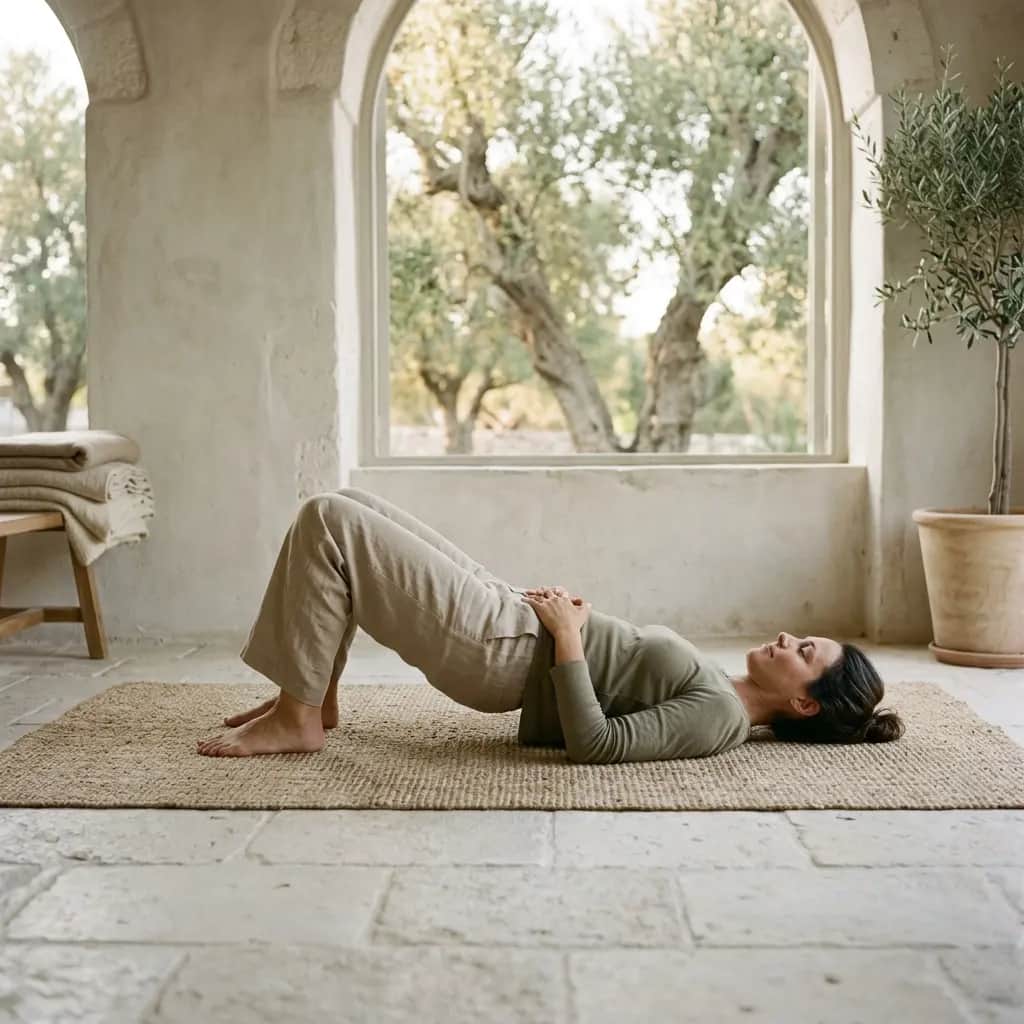
Lie on your back with your heels on the two pads, knees bent. Press your heels down and lift your hips into a low bridge. Slide one heel away a short distance, then pull it back. Alternate legs for 6 to 8 per side. Cue: keep the hips level, as if balancing a cup of tea on your belly. Easier: keep the hips down and just slide the heels. Harder: slide both heels out together. For more glute work off the board, see our ankle weight exercises for glutes and legs.
2. Kneeling knee tucks (core)
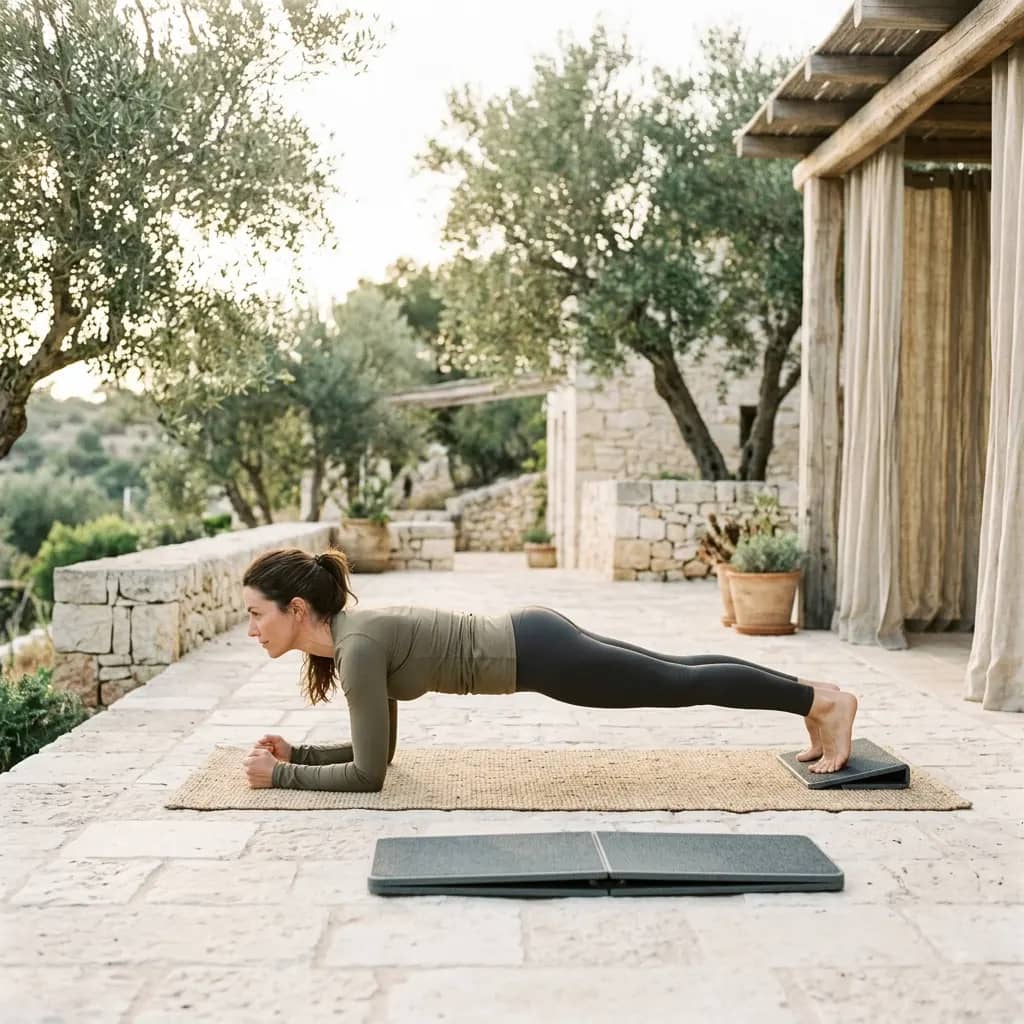
Kneel facing the board with your hands on the floor or the handles and your knees on the pads, so you are in a tabletop position. Slide both knees back a short distance, then draw them forward under your hips. Do 8 to 10. Cue: keep your back still; the movement happens at the hips. Harder: later, try a plank with your feet on the pads.
3. Reverse lunge slide (legs, balance)
Stand beside the board with one foot on a pad, holding a chair or wall if you like. Slide that foot back as you bend the front knee, then pull it back in. Do 6 to 8 per side. Cue: most of your weight stays on the front heel. Easier: smaller slide, more support from the chair.
4. Side lunge slide (inner and outer thighs)
Stand with one foot on a pad. Slide that foot out to the side as you bend the standing knee and sit your hips back, then draw it in. Do 6 to 8 per side. Cue: keep the standing knee pointing over your toes.
5. Incline push-up on handles (chest, arms, core)
Put the handles on the board, kneel behind them and walk your knees back until your body forms a line from head to knees. Bend your elbows to lower your chest a few inches, then press back up. Do 6 to 10. Easier: do the push-up standing, with hands on a kitchen counter. Harder: full plank from the toes.
6. Single-arm slide in tabletop (shoulders, core)
On hands and knees, one hand on a pad. Slide that hand forward a short distance and back. Do 5 to 6 per side. Cue: do not let your hips sway; brace lightly as if someone might nudge your side.
7. Banded row (upper back, posture)
Sit tall on a mat with legs bent and the band hooked around the far end of the board or your feet. Pull the band handles toward your lower ribs, squeezing the shoulder blades gently together, then release slowly. Do 10 to 12. Cue: shoulders away from the ears. This move supports the posture work many of us need after desk days, along with short desk yoga breaks during the workday.
Your 3-Week Beginner Plan
Three sessions a week, on non-consecutive days, about 15 to 20 minutes each. Warm up with 2 minutes of marching on the spot and shoulder rolls, much like the movement snacks in our quick exercises for busy days.
| Week | Exercises | Sets and reps | Slide range | Focus |
|---|---|---|---|---|
| 1 | Bridge slides, kneeling knee tucks, incline push-up, banded row | 1 to 2 rounds, low end of reps | About a third of the track | Learn the slide, breathe out on the return |
| 2 | Add reverse lunge slide and side lunge slide | 2 rounds | Up to half the track | Smooth return at the same speed as the slide out |
| 3 | All seven moves | 2 to 3 rounds | Comfortable full range | Steady trunk, no sway or rushing |
Move to the next week only when the current one feels controlled. If week 2 feels hard, repeat it. After three weeks, progress one thing at a time: more range, then more reps, then harder versions such as the plank knee tuck.
Common Mistakes on a Pilates Board
- Letting the slide pull you. If the pads move faster than you meant, the range is too big.
- Holding your breath. Breathe out on the hardest part of each move.
- Sagging hips in plank or tabletop moves. Shorten the slide or drop to the knees.
- Copying reformer videos. Exercises designed for springs and a carriage do not translate to a sliding-pad board.
- Going for speed. Pilates-style work is about control. Slow and smooth gets more out of each rep.
How It Fits With the Rest of Your Week
A board session works well alongside walking, such as our 30-day walking challenge or the Japanese walking method, and the other gentle routines in our exercise guides. If you want a broader view of everyday strength for daily life, our guide to functional fitness at home is a good companion. And because you will be on the floor for much of the session, a mat with decent grip helps; our yoga mat guide explains the trade-off between grip and cushioning.
Frequently Asked Questions
Is a Pilates board the same as a reformer?
No. A reformer is a studio machine with a rolling carriage attached to springs. A foldable Pilates board sits on the floor and usually uses sliding pads, handles and resistance bands, so the exercises are different. Reformer routines generally cannot be copied onto a board.
Are Pilates board exercises good for beginners?
Yes, if you start with short slides and simple moves such as bridge slides, kneeling knee tucks and incline push-ups. The main risk for beginners is letting the pads slide too far, too fast. Keep the range small for the first week or two.
How often should I use a Pilates board?
Two or three sessions a week of 15 to 20 minutes is a sensible start, with a rest day in between. Consistency over several weeks matters more than long sessions.
Can I do Pilates board exercises without a board?
Mostly, yes. Two small towels on a smooth floor, or furniture sliders on carpet, can replace the sliding pads for bridge slides, knee tucks and lunge slides. A resistance band looped around your feet works for rows.
Is a Pilates board safe with osteoporosis or back pain?
It can be, with the right choices. Avoid deep forward-rounding moves such as roll-ups, keep slides small, and stop if anything causes pain. Check with your doctor or a physical therapist before starting if you have osteoporosis, a back condition or a recent injury.